


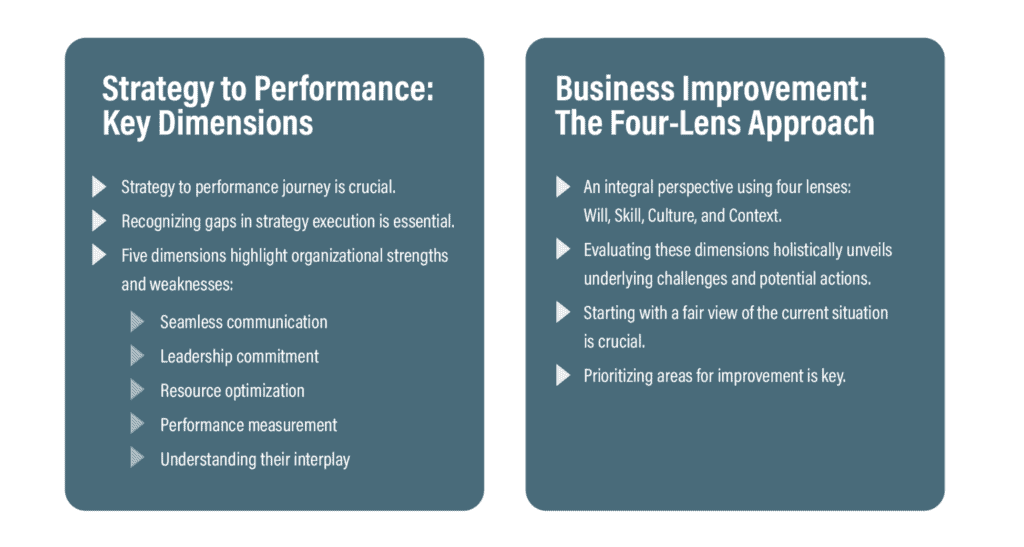
Companies achieve on average just over 60% of what their strategic plans set out. That shortfall is the strategy-performance gap, and it is rarely caused by a bad strategy. It accumulates across five specific dimensions, each of which can be diagnosed and each of which needs a different intervention.
The cost shows up first in the numbers: revenue opportunities that were planned and never realised, operating costs that were meant to come down, market share that erodes while the plan sits in a deck. It also shows up in places that are harder to measure, in the credibility of leadership and the willingness of teams to take the next plan seriously.
Five drivers behind the execution gap
The drivers cluster along five dimensions. Each one produces a recognisable failure pattern, and each has its own set of levers.
1. Clarity of strategy
A strategy that leaves room for interpretation gets interpreted differently in every department. Teams then optimise for locally sensible goals that do not add up. What decides clarity is how simple the strategy is, how many levels and departments were involved in designing it, and whether employees can say how their own work contributes to it.
Levers for clarity of strategy:
- Clarity of strategic objectives
- Consistency of strategic goals
- Specificity of strategic actions
- Alignment of strategy with organisational vision and mission
- Flexibility and adaptability of strategy
2. Communication and alignment
Siloed operations stifle information flow, which produces inconsistencies in goal-setting between units that are supposed to be working towards the same outcome. Alignment has two axes: vertical, so that leadership and operational teams pursue the same goals, and horizontal, so that departments do not duplicate or block each other.
Levers for communication and alignment:
- Vertical alignment between leadership levels and operational teams
- Horizontal alignment across departments and functions
- Clear roles and responsibilities for every strategic goal
- Continuous updates whenever the strategy changes
- Feedback that travels bottom-up, not only top-down
3. Leadership commitment
Commitment is measured by what is visible to the rest of the organisation, not by what leadership intends. Where top management is inconsistent about strategic priorities, the ranks read the inconsistency accurately and hedge. Ownership, accountability, and leading by example are what make commitment legible.
Levers for leadership commitment:
- Visible support and involvement of top leadership
- Clear communication of strategic priorities by leaders
- Empowerment and support for decision-making at all levels
- Accountability of leaders for strategy execution
- Continuous development and improvement of leadership skills
4. Allocation of resources
Resource allocation is where a strategy is either funded or quietly declined. The relevant capabilities are managing and allocating assets against strategic goals, using specific KPIs to guide business planning, and adjusting allocation as the business changes. Misallocation shows up as initiatives that are formally live and practically unstaffed.
Levers for resource optimisation:
- Prioritisation of strategic initiatives
- Efficient allocation of financial, human, and technological resources
- Flexibility in resource allocation to adapt to changing circumstances
- Monitoring and control of resource utilisation
- Alignment of resource allocation with strategic goals
5. Performance measurement
Without KPIs tied to the strategic objectives and a regular reporting rhythm, progress is a matter of opinion. Measurement also fixes accountability at the operational level, which is where most execution decisions are actually taken. The requirement is a consistent framework whose link to the strategy is explicit.
Levers for performance measurement:
- Establishment of clear performance metrics and key performance indicators
- Regular monitoring and reporting of performance
- Alignment of performance metrics with strategic objectives
- Use of performance data for decision-making and strategy adjustment
- Continuous improvement based on performance feedback
Four lenses for finding which driver is binding
Naming the five drivers does not tell you which one is the constraint in a specific organisation. Drawing on integral theory by Ken Wilber, an organisational system can be read through four lenses that cut across all five drivers.
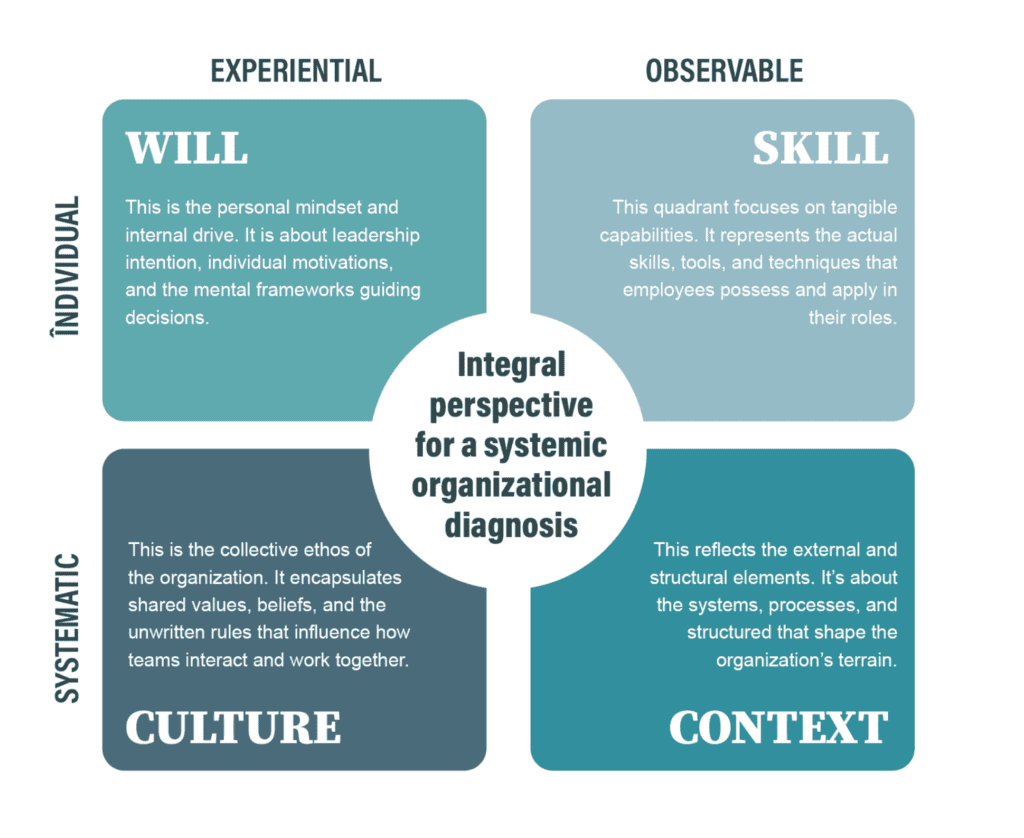
Will is the individual mindset: leadership intention, personal motivation, and the mental frameworks behind decisions. Skill is individual capability made tangible, meaning the actual skills, tools, and techniques people apply in their roles. Culture is the collective ethos: shared values, beliefs, and the unwritten rules that govern how teams work together. Context is the structural layer, the systems and processes the organisation runs on. Two lenses are individual and two systemic. Two describe what can be observed and two what cannot.
The lenses are diagnostic and prescriptive at once. A weakness on the will side points towards coaching. A cultural barrier calls for leadership intervention to rebuild narratives of success. Reading a symptom without picking the lens first produces the wrong intervention.
How to get started
Start with a fair view of the current situation and keep the first pass simple. Collect the available views and data, structure them against the organisation's stated ambitions, and accept that not all aspects can or should be addressed at once.
A systematic assessment across the dimensions works best: surveys, interviews, and analysis of the data that already exists. Once the current state is understood, identify the gaps and prioritise the areas that need attention most. The output of that first pass is a ranking, and the ranking is what makes the next twelve months of execution work different from the last twelve.
About scaleon
scaleon is a boutique consultancy focused on strategy and strategy execution, with extensive expertise in the design and roll-out of OKR systems. scaleon was founded by experienced entrepreneurs and senior executives Stefan Benndorf and Dr. Philipp Engelhardt, driven by a passion for working in fast-moving, dynamic, and challenging business environments and solving complex strategic problems for their clients. Clients include well-known technology companies, mid-sized enterprises, and large corporations. In 2022, scaleon was awarded the prestigious Top Consultant Award.