

Why AI spend needs a value case
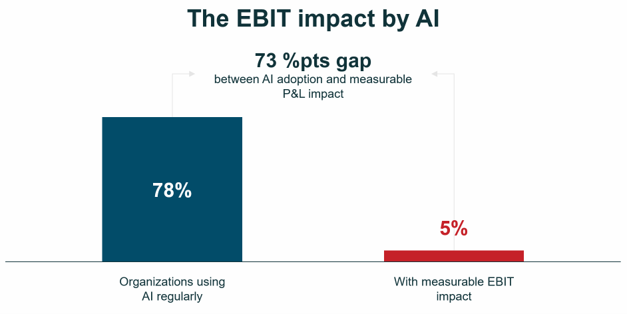
The level of investment is substantial. Corporate AI investment reached around USD 252 billion in 2024, and 78% of organizations now report using AI. Adoption has spread faster than the personal computer or the internet did.
The AI ROI is far less certain. MIT NANDA examined 300 public AI deployments and found 95% of pilots with no measurable impact on the profit and loss statement, and only around 5% creating significant value (MIT NANDA, 2025). The picture from the financial side is consistent: McKinsey surveyed close to 2,000 organizations, of which 39% attribute any EBIT effect to AI and only around 5% clear the 5%-of-EBIT mark (McKinsey, State of AI 2025). Most of AI's economic value already accrues to a small group of organizations that keep extending their lead.
In 2025, 42% of companies abandoned most of their AI projects, in most cases not for technical reasons but for unclear business value.
What separates the companies pulling ahead from the ones spending without return is not how much they invest or how early they moved, but whether they understood the value contribution of a move before committing to it.
Why most AI projects fail
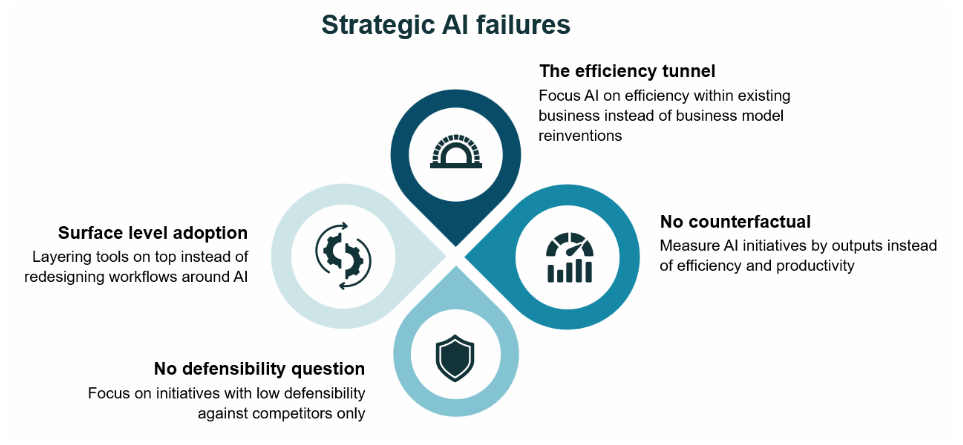
Four patterns recur:
- The efficiency tunnel: AI is used to do the same things cheaper. The more valuable questions about growth and positioning go unasked. The result is a portfolio of small, replicable savings that competitors can match with the same tools from the same vendors. The companies that capture disproportionate value do the opposite: they are 2.6 times more likely to use AI for business model reinvention than for cost reduction alone
- No counterfactual: Value is booked without asking what would have happened anyway. Much of what gets counted as new value would have materialized regardless, through market growth or falling technology costs. Only 36% of CFOs feel confident they can deliver real business impact from AI, in large part because organizations measure inputs like productivity instead of outputs like revenue and margin
- Surface-level adoption: AI laid on top of an unchanged process returns very little. Rebuilding the surrounding workflow lifts the share of tasks AI can meaningfully improve from about 15% to roughly half. The constraint is rarely the model
- No defensibility question: Too rarely does anyone ask whether the value created stays with the company or gets competed away. A capability every competitor can buy from the same vendor creates value that flows to customers through lower prices, not to the company through higher margins
These failures compound. A company in the efficiency tunnel naturally skips the defensibility question, and a team that never models a counterfactual cannot tell whether an initiative is creating value or merely preserving a baseline.
How an AI value case ensures value creation
A credible AI value case rests on three moves, and each can only be judged off the specific business.
Quantify the impact before committing. Most companies invest without a clear view of what an initiative contributes to the P&L, by how much, or how that contribution develops as the market moves. Establishing that impact first is where the value case starts. It draws on six diagnostic layers: business model exposure, competitive position, revenue and growth, operating model, risk and timing, and organizational readiness. Together they show where AI value sits for a specific company and how defensible it is. Without this groundwork, every figure that follows rests on assumption rather than evidence
Manage the value you keep. The value an initiative creates and what the company retains are rarely the same number. Three things decide how much reaches the P&L: how defensible the initiative is, what it costs at scale, and how competitors respond. Cost alone behaves unlike traditional software, scaling with usage rather than headcount and driven more by inference than training, which is why 80% of organizations miss their AI cost forecasts by 25% or more (CloudZero, 2025, vendor survey). The rest is leakage, the difference between value created and value retained:
AI leakage = AI value created − AI value captured
It leaks in three directions: to competitors running the same tools, to customers through lower prices, and to vendors through infrastructure and licensing. What stays comes down to defensibility. An initiative built on proprietary data, embedded in a redesigned workflow, and tied to a unique position keeps most of what it creates. One built on a third-party model and bolted onto an unchanged process keeps almost none. The headline gain is rarely the amount ultimately retained.
Plan across all three horizons. Some initiatives defend and improve the core, others grow new revenue, and others transform the business model, and they mature on different timelines. Impact has to be assessed and managed for today and for the years ahead, not booked as a single static number.
The AI value case framework
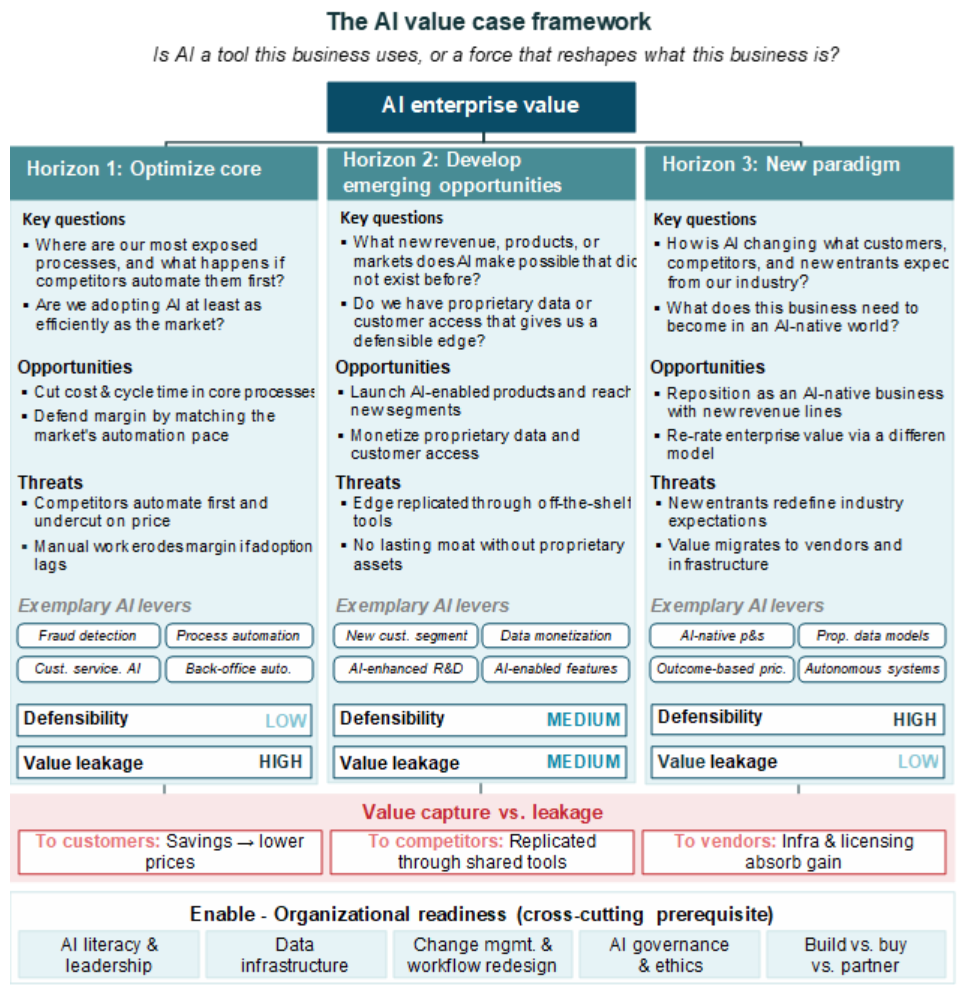
AI value does not arrive all at once. The framework maps initiatives across three horizons, each with different strategic implications, and a different leakage profile. All three require investment today.
- Horizon 1 - Optimize core: efficiency gains in existing processes, live in weeks to months. Low defensibility, high leakage. The case here is less about advantage and more about avoiding disadvantage as competitors automate
- Horizon 2 - Develop emerging opportunities: new products, segments, and revenue that did not exist before AI made them possible. Medium defensibility, medium leakage, and heavily dependent on whether the company builds on proprietary assets
- Horizon 3 - New paradigm: repositioning as an AI-native business. High defensibility, low leakage, longest time to value, and the greatest strategic significance. The challenge here is not leakage but managing strategic bets under uncertainty
How scaleon builds the case
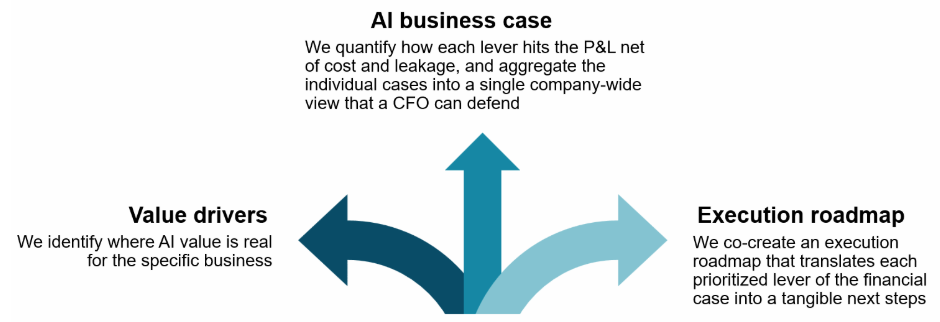
scaleon turns the analysis into an investment decision in three steps.
First, identify the value drivers across all three horizons using the six-layer diagnostic. The output is a ranked longlist of AI value drivers, positioned by horizon, P&L line, and defensibility. Most companies never get past this step, because they only ever consider cost savings.
Second, build the AI business case bottom-up. Each prioritized lever is quantified over a 5 to 10-year horizon, with benefit mapped to the P&L line it affects and cost modeled at production scale net of leakage. Every lever is modeled across a corridor of base, best, and worst cases, and set against a do-nothing counterfactual, which is rarely flat and on a fragile business slopes down. The individual cases aggregate into a single company-wide view a CFO can read and challenge in two minutes.
Third, co-create the execution roadmap that translates each lever into tangible next steps: what launches first, what it requires, who owns it, and how near-term horizon 1 gains fund the longer-dated horizon 2 and 3 bets. That self-financing logic is what makes the case executable rather than merely defensible.
The AI value case: the questions we get asked most
What is an AI value case?
A structured assessment of where an AI investment creates value, how much of that value the company will actually keep once competitors, customers, and vendors take their share, and over what time horizon. It runs on six diagnostic layers: business model exposure, competitive position, revenue and growth, operating model, risk and timing, and organisational readiness.
Why do most AI projects fail to show a return?
Four recurring patterns: optimising for cost instead of growth, the "efficiency tunnel"; booking value without a counterfactual for what would have happened anyway; applying AI to an unchanged process instead of redesigning the workflow around it; and never asking whether the value created is defensible or will be competed away.
What is AI leakage?
The difference between the value an AI initiative creates and the value the company actually retains. Value leaks in three directions: to competitors running the same tools, to customers through lower prices, and to vendors through infrastructure and licensing costs.
What are the three AI value horizons?
Horizon 1 optimises the core business with fast, low-defensibility, high-leakage gains. Horizon 2 builds new revenue that AI makes possible, with medium defensibility. Horizon 3 repositions the business as AI-native, with the highest defensibility, the lowest leakage, and the longest time to value.
Bottom line
The companies that win the next few years with AI will be those that worked out early where the value sticks and built the case from there. The first move is not to pick a tool or launch a pilot, but to test the business: establish which pattern it sits on, trace where its value leaks, and isolate the few levers that are both large and defensible. Only once that logic is in place does spending become an investment rather than a hope.