


Strategy execution is one of the greatest challenges for companies and is widely regarded as the "supreme discipline" of strategic management. Despite careful planning, companies achieve on average just over 60% of their stated goals.
In the context of transformations, up to 70% of change management initiatives fail. This gap between strategic planning and actual execution - what we call the performance gap - can have significant consequences for the competitiveness and long-term success of a company.
"Strategy is a commodity, execution is an art."
– P. Drucker

As a management consultancy, we understand the complexity behind successful strategy execution. In this article, we examine the causes of this performance gap and present concrete approaches for how companies can overcome it.
We show how an effective connection between strategy, structure, and culture helps not only to reach planned goals, but to exceed them.

Strategy Execution: Six Main Causes of the Performance Gap
Based on our research and collaboration with clients, we have identified six dominant patterns that frequently account for performance or underperformance in strategy execution.
Clarity of strategy
A strategy can only succeed if it is formulated clearly and comprehensibly for all employees. Unclear goals and vague formulations create confusion and prevent departments and teams from working together effectively.
Regular and comprehensive communication
To truly bring a strategy to life, continuous and transparent communication is essential. Leaders must consistently convey the strategic goals at all levels of the company and ensure that progress and challenges are discussed openly.
Vertical and horizontal alignment
Strategy execution works best when all levels of the hierarchy and all departments are aligned with one another. Vertical alignment ensures that leaders and operational teams pursue the same goals. Horizontal alignment promotes collaboration between different departments and concentrates company-wide focus on the right topics.
Resource allocation
Successful strategy execution requires not only clear goals, but also the right and ongoing allocation of resources. Financial, human, and technological means must be adjusted flexibly in order to support strategic priorities adequately.
Individual and organisational capabilities
The execution of a strategy depends to a significant degree on both the individual competencies of employees and the capabilities of the organisation as a whole being developed and deployed optimally. Through investment in technology, process optimisation, and organisational development, the organisation can increase its collective performance capacity.
Performance management and steering
To safeguard the progress of the strategy, regular performance monitoring is essential. Clear key performance indicators (KPIs) and consistent monitoring enable targeted governance and rapid adjustments when actual developments deviate from plans.
Understanding the current strengths and weaknesses across these dimensions is a very good starting point. We have brought together the six dimensions in our Strategy Execution Canvas. Management teams can ask themselves how strongly or weakly their organisation is positioned on each individual dimension. A systemic perspective is well suited to a thorough diagnosis. For each of the dimensions there are instruments that can help to manage it more effectively. There is, however, no simple answer: designing the right instruments is highly individual and must fit the culture, structures, and mindset within the organisation.
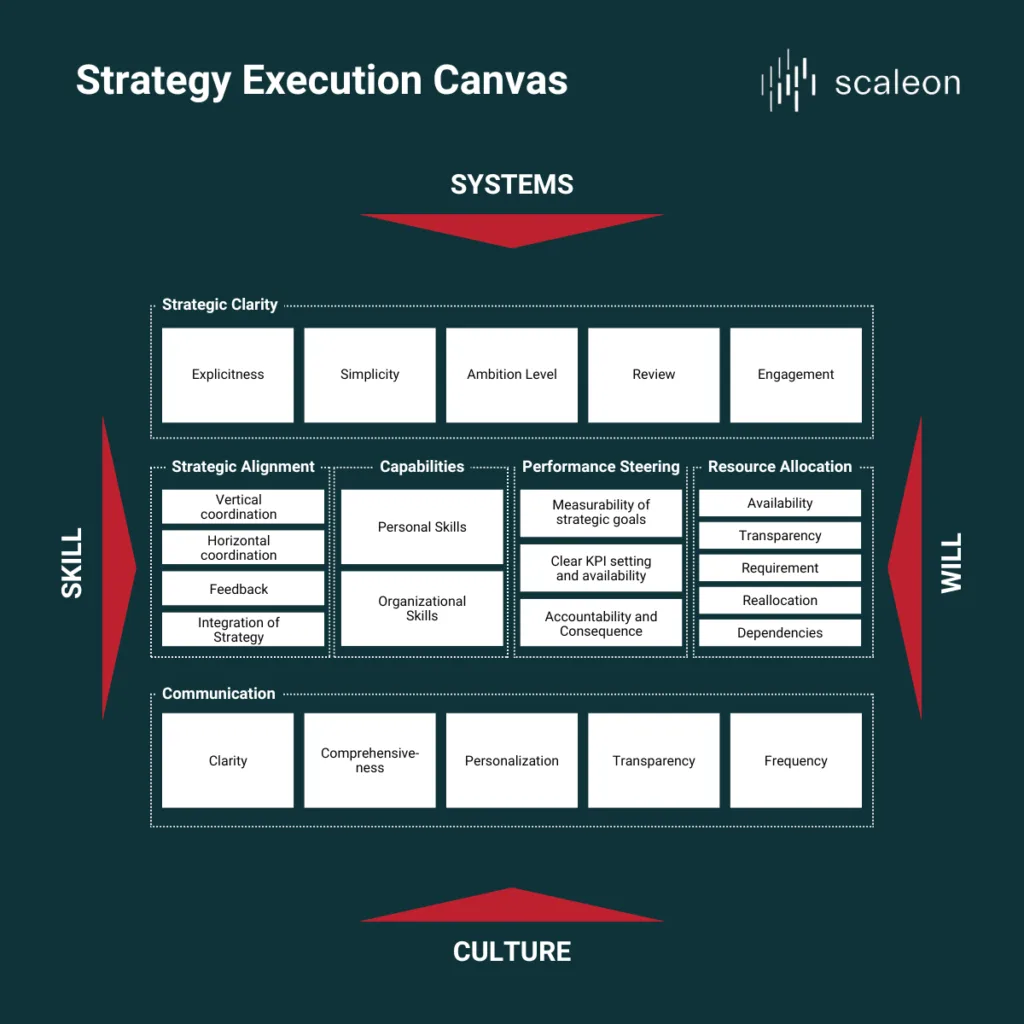
The canvas helps to structure these dimensions using guiding questions and to carry out a self-assessment. For this purpose, we use a scoring system and a deep qualitative analysis to identify and layer the underlying causes.

Dimensions of strategy execution
Strategic clarity
Strategic clarity ensures that the direction and goals of a company are documented in a way that is unambiguous and comprehensible to all those involved. It creates a shared point of reference that ensures all employees can work in a targeted and coordinated manner toward the execution of the strategy.
- Explicitness: A clearly documented strategy ensures that the long-term corporate goals are known and understandable at all levels of the organisation. This is essential for all team members to be able to understand their specific roles and tasks in the context of the overarching strategy and fulfil them effectively.
- Simplicity: Strategies should be formulated in clear, straightforward language that leaves little room for interpretation. Clear and simple language not only promotes understanding but also increases employee motivation, as they can clearly recognise and act on the goals and steps involved.
- Level of ambition: The goals set must be realistic and achievable, aligned with the available resources and capabilities of the company. Unrealistic ambitions frequently lead to frustration and demotivate teams, while achievable goals provide orientation and a positive working environment.
- Regular review: Strategies must be reviewed regularly and adjusted to changing conditions. Such continuous evaluation by the leadership ensures that the strategy remains relevant and effective at all times and that the set goals are reached despite external changes.
- Involvement: Involving different stakeholders with varied perspectives and expertise in the strategy process promotes innovation and improves the quality of strategic planning. Broad participation contributes to acceptance and engagement across the entire company, as employees identify more strongly with the strategy.
Alignment
Company-wide alignment ensures that all levels and areas of the company, from departments and teams through to executives, work in a coordinated and mutually aligned manner with respect to the strategy. This alignment enables the strategic goals to be pursued efficiently.
- Vertical coordination: A clear alignment between hierarchical levels ensures that executives and operational teams share a common understanding of the strategy. This improves performance tracking and promotes a consistent strategic direction.
- Horizontal coordination: Collaboration between different departments and teams increases transparency and promotes synergies. An integrated approach reduces effort and avoids duplication of work.
- Feedback: A regular flow of information in both directions, top-down and bottom-up, ensures that strategy adjustments are communicated effectively at all levels. Employee feedback supports successful strategy execution.
- Integration of strategy: All activities and processes within the company should be strategically aligned in order to ensure a high degree of consistency and goal orientation. This is particularly important for operational teams at the front line.
Communication
An effective communication approach ensures that the strategy is conveyed clearly and in a targeted manner to all relevant stakeholders. This includes the selection of the right channels and messages as well as the gathering and use of feedback.
- Clarity: The strategy should be communicated in clear and direct language in order to minimise misunderstandings and improve resource alignment.
- Scope: Communication must cover all essential strategic elements to ensure a complete understanding of the goals and the process.
- Personalisation: Different stakeholders require information tailored to their needs in order to support the strategy optimally. Target-group-appropriate communication improves effectiveness.
- Transparency: Openness about progress and challenges in the strategy strengthens accountability and employee trust.
- Frequency: Regular communication promotes engagement with the strategy and keeps employees involved.
Resource allocation
Effective resource allocation ensures that strategic goals are supported by the available means such as personnel, capital, and time. This is essential for the successful execution of the strategy.
- Availability: It must be ensured that sufficient resources are available to achieve the strategic goals.
- Transparency: All levels of the organisation should be informed about the availability and allocation of resources in order to ensure efficient use.
- Requirements: The quality and quantity of resources needed must be carefully assessed and appropriately assigned in order to maximise productivity.
- Reallocation: A flexible approach to resource adjustment enables rapid responses to change and optimises strategy execution.
- Dependencies: Taking into account dependencies between different initiatives and units promotes efficient resource use and collaboration.
Integration of capabilities
The integration and further development of individual and organisational capabilities ensures seamless strategy execution. This includes the systematic alignment of employee qualifications and organisational structures with strategic requirements.
- Employee competencies and skills: Continuous assessment and development of employee capabilities ensures that the competencies needed for strategy execution are in place.
- Organisational capabilities: The targeted identification and strengthening of capabilities required to achieve strategic goals promotes strategic alignment and performance.
Performance steering
Systematic performance measurement and governance makes it possible to monitor the progress and effectiveness of strategy execution and to adjust course where needed.
- Measurability of strategic goals: By setting clear, measurable goals, progress can be monitored and the strategy adjusted where necessary.
- Defining and making KPIs available: The definition and provision of appropriate KPIs facilitates the monitoring and steering of strategic progress.
- Accountability and consequences: A clear understanding of responsibilities and potential consequences in the event that goals are not met promotes targeted and focused execution.

Conclusion
The path from strategy to performance is complex, and understanding the gaps in strategy execution is essential. The six dimensions discussed - strategic clarity, company-wide alignment, communication approach, resource allocation, integration of capabilities, and performance measurement and governance - help to identify the strengths and weaknesses of an organisation. A comprehensive approach that takes into account the four perspectives of will, capability, culture, and context provides a structured way forward.
A thorough assessment of these dimensions enables companies to recognise the underlying causes of challenges and take appropriate action. The key lies in developing a realistic picture of the current situation and prioritising the areas with the greatest need for improvement.
Strategy execution: the questions we get asked most
What is strategy execution?
Strategy execution is the work of turning a formulated strategy into results: allocating resources, aligning teams, and tracking progress against goals. It sits downstream of strategy development, which sets the direction, and is where most of the value of a strategy is actually won or lost.
Why does the gap between strategy and results happen?
Six causes account for most of it: unclear strategy, weak communication, misaligned vertical and horizontal coordination, poor resource allocation, capability gaps, and inconsistent performance steering. None of them is a planning failure; all six are execution failures that a good strategy on paper cannot fix by itself.
What is the Strategy Execution Canvas?
A self-assessment framework covering the six dimensions of execution. A team scores how strong or weak the organisation is on each dimension, then uses that score to prioritise which one to fix first, since the six typically differ substantially in maturity within the same company.
What are the four perspectives of will, capability, culture and context?
A complementary lens for diagnosing why execution stalls in a specific organisation: whether people are motivated to execute (will), equipped to (capability), supported by norms to (culture), and operating in a structure that allows it (context). It complements the six-dimension canvas rather than replacing it.
How is strategy execution different from strategy development?
Strategy development sets the direction and the goals. Strategy execution builds the organisation, resource allocation, and steering that deliver them. Most of the shortfall between plan and result sits in this second half, not in the quality of the strategy itself.