

What is a Target Operating Model (TOM)?
The Target Operating Model (TOM) describes the target picture of how a company should be organised and operated in order to achieve its strategic goals. It is the operating system of the organisation in its intended state: it defines how processes, technology, structures, governance and roles work together to turn a corporate vision into delivery.
Why is it relevant for companies?
Strategy failure is usually a problem of organisational design. The organisation that has to execute the strategy was built for a different set of goals, and sharper formulation does not fix that. A TOM closes the gap by making the target state explicit and testable: who owns which part of the value chain, which decisions are taken at which level, and which metrics show whether it is working.
What an operating model actually contains
Definition: the operating system of the organisation
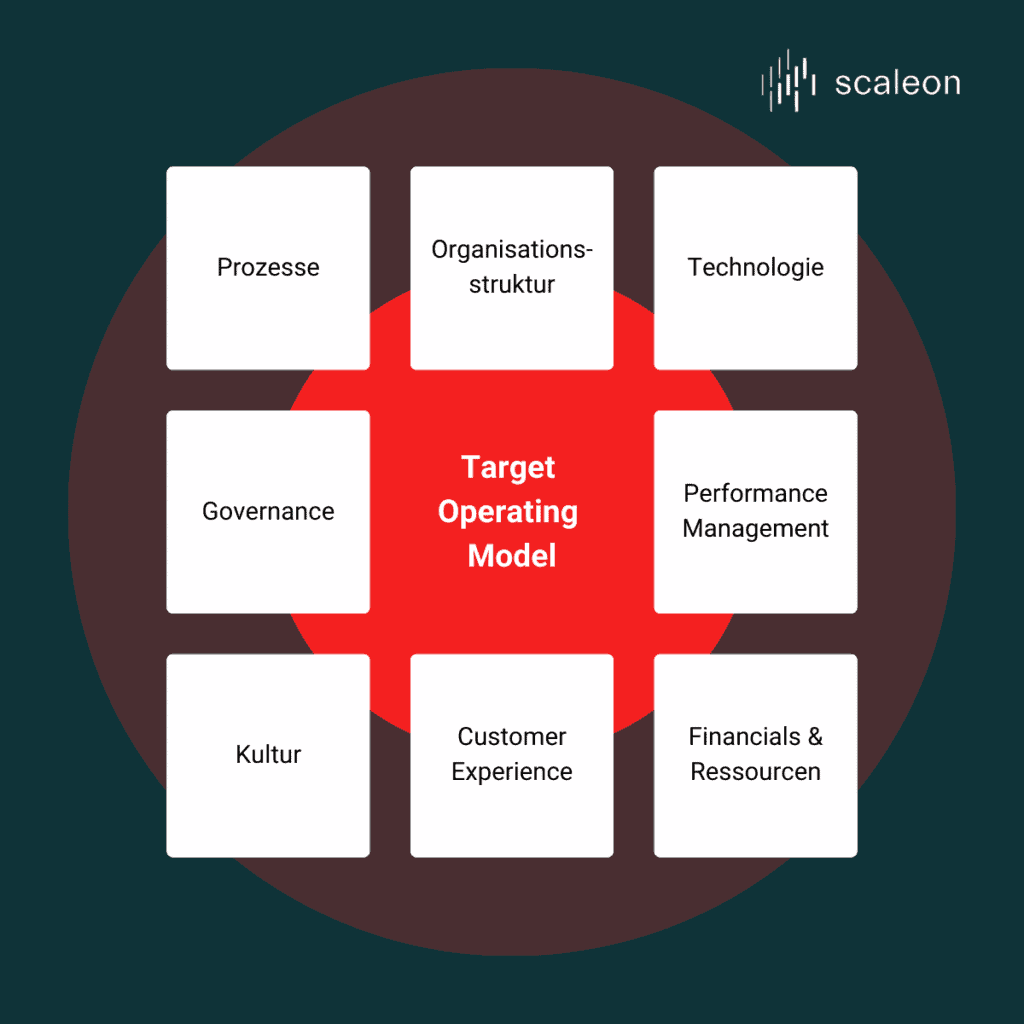
An operating model describes the way in which a company functions. It contains all the central components necessary for operations, including:
- Processes: How work gets done.
- Organisational structure: How teams and responsibilities are divided.
- Technology: The supporting tools and systems.
- Governance: Policies that ensure everything runs according to plan.
- Performance management: Clear mechanisms for measuring and optimising performance on the basis of strategic goals.
- Culture: The unwritten rules and values that shape behaviour.
- Customer experience: The interface with the customer.
- Financials and resources: The financial and human resources required.
Core components: what makes up an operating model?
The operating model provides the framework within which a company's strategy is realised in day-to-day operations. It is important to review this framework regularly, as changes in the market environment, in technology, or in corporate goals may necessitate adjustments. A poorly defined operating model can lead to inefficiencies and slow the success of an organisation. It is therefore essential to define clearly how the various elements are connected to one another.
The target picture: the Target Operating Model
Distinction from the current operating model
While the operating model describes the current state of a company, the "as-is", the Target Operating Model (TOM) is the desired target picture: the "to-be." It is the design that aims to support strategic goals more effectively through optimised processes, technologies, and structures. The TOM distinguishes itself from the as-is state by specifically closing the gaps between current conditions and desired outcomes. These gaps frequently arise from outdated processes, inefficient structures, or insufficient resources. A well-considered TOM provides a clear roadmap for addressing these challenges.
Purpose and goals of the target design
The goal of a TOM is to position a company so that it can respond flexibly to market changes and execute its strategy efficiently. This includes:
- Efficiency gains: Reduction of process inefficiencies.
- Clarity: Unambiguous responsibilities and roles.
- Strategy execution: An unbroken path from planning to execution.
- Customer centricity: Optimisation of customer journeys and customer experiences.
The transformation process: from as-is to to-be
The development of a TOM begins with a thorough analysis of the current operating model. Weaknesses are identified and prioritised. In the next step, a detailed target design is created that takes into account the most important dimensions:
- Processes: Which workflows need to be changed or optimised?
- Technology: Which tools and systems best support the strategy?
- Structures: How do teams and departments need to be reorganised?
- Resources: What capacities and capabilities are required?
An effective transformation process is iterative. This means companies should regularly review whether the planned measures are delivering the desired results and make adjustments where necessary.
The connection between strategy and execution
Typical gaps between strategy and execution
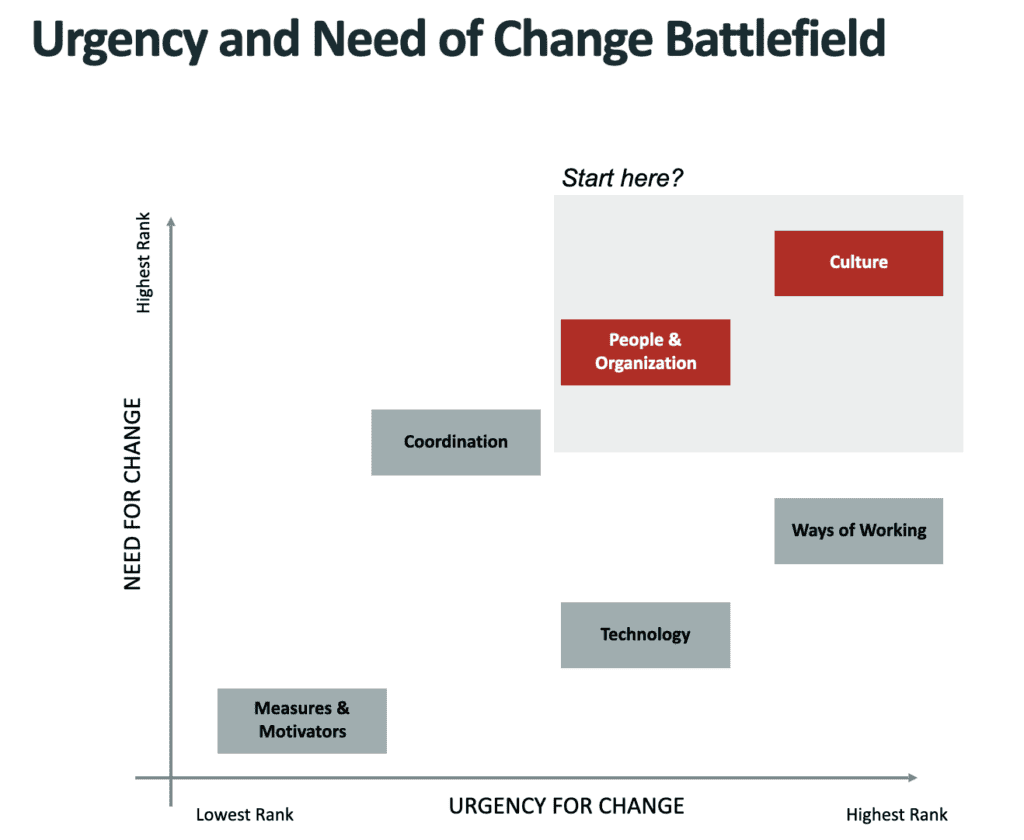
One of the most common reasons why strategies fail lies in execution. Across our operating model work with digital companies, the gaps cluster in four areas:
- Resource allocation: Resources are not distributed optimally.
- Communication: Strategic goals are not communicated clearly.
- Governance: Missing mechanisms for monitoring progress.
- Technology: Insufficient systems to support strategy execution.
These gaps can result in even the best strategies having no effect. The TOM helps to address these gaps systematically by creating clear specifications for each area.
The role of the Target Operating Model in closing these gaps
A TOM acts as a bridge between strategy and execution. It provides clear guidance on how strategic goals can be translated into operational processes. By addressing the most important levers, from processes through to technology, the TOM removes the barriers to coherent execution.
Methodology for developing a Target Operating Model
Analysis of the status quo
The first step in developing a Target Operating Model is a thorough analysis of the current operating model. This examines how the company currently functions and identifies weaknesses and opportunities for improvement. Key questions include:
- Which processes are inefficient or error-prone?
- Where are there misunderstandings around responsibilities?
- Which technologies support the strategy and which hinder it?
- Are the available resources sufficient to achieve the goals?
Dimensions of a Target Operating Model
A TOM covers several dimensions that must be aligned with one another in order to execute the strategy successfully. The most important dimensions include:
- Governance: Clear guidelines for decision-making and responsibilities.
- Processes: Efficient workflows that support the strategy.
- Technology: Use of modern tools for automation and data analysis.
- Organisational structure: Teams and departments that can collaborate in an agile manner.
- Performance management: The introduction and embedding of a system for monitoring and governing KPIs that safeguards progress toward corporate goals and creates transparency.
- Culture: Values and convictions that promote effective collaboration.
- Resources: The right capabilities, capacities, and financial means.
Roadmap for the transformation
Following the analysis and definition of the target picture, a roadmap is created that divides the transformation process into manageable phases. This could look as follows:
- Short-term measures: Immediately actionable quick wins such as process optimisations or technology upgrades.
- Medium-term steps: Restructuring of the organisational structure and introduction of new tools.
- Long-term goals: Embedding the new way of working into the corporate culture and continuous optimisation.
A target operating model example: a European energy-software platform
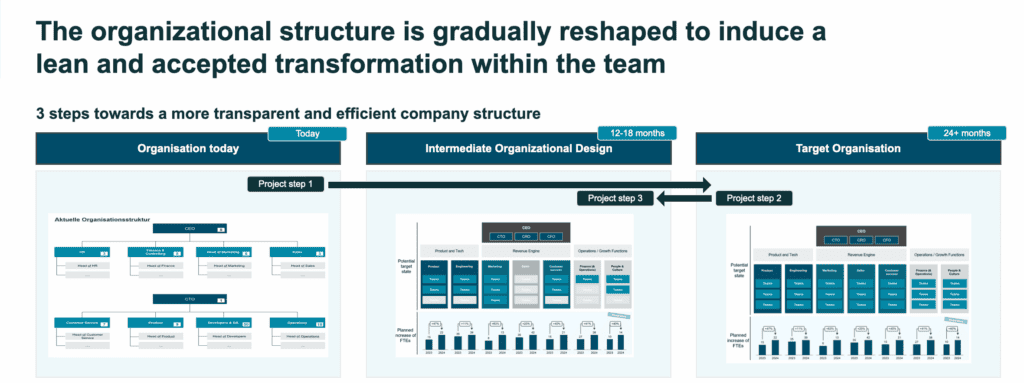
This example comes from a recent scaleon engagement that ran 5 months, with a B2B software platform in the European energy market. The company had emerged from a corporate spin-off and its organisation still carried that origin: central C-1 positions were missing, responsibility for the customer journey was scattered across units, and the product organisation absorbed work that belonged elsewhere.
Two design principles did most of the work: design the organisation for scalability rather than around current personnel, and transition on what is feasible rather than what is desirable.
Four dimensions changed together:
- Value chain. From an unclear end-to-end customer journey and an overloaded product organisation, to clear ownership at every stage of the customer lifecycle.
- Organisational structure. From missing C-1 positions and scattered responsibilities, to defined C and C-1 responsibilities and functions built for scalability.
- Strategic planning. From a largely ad-hoc process, to strategy formulation owned at C-level and dedicated frameworks for every planning step.
- KPI ownership. From limited KPI steering, to KPIs used both to translate strategy and as health metrics with named owners.
The design went down to operating detail: 47 strategic initiatives at C-1 level derived from the strategic goals, 4 to 7 per department, 3 to 7 KPIs per department reported monthly, quarterly OKR cycles with check-ins every two weeks. The transition ran in three stages, from today's structure through an intermediate design at 12 to 18 months to the target organisation at 24 months or more.
The org chart was the smallest part of the work. What made the design hold was moving the planning rhythm and the metrics with it, because left unchanged they keep steering towards the goals the company had before.
Best practices and pitfalls
Success factors in implementation
To implement a Target Operating Model successfully, companies should take the following success factors into account:
- Involving stakeholders: All relevant parties, from executives through to operational teams, should be involved at an early stage.
- Clear communication: The target picture and the path toward it must be understandable to everyone.
- Flexibility: The willingness to adapt the model where necessary is essential.
- Pilot projects: Small test runs help to identify and address potential problems at an early stage.
Common challenges and how to overcome them
Typical pitfalls in the implementation of a TOM include:
- Resistance to change: Employees and executives can be sceptical, particularly if the benefits of the TOM are not communicated clearly. Solution: involve the team at an early stage.
- Unrealistic goals: A TOM can only succeed if it is realistic and actionable. Solution: clear prioritisation and iterative execution.
- Insufficient resources: Without the right means, the TOM remains theoretical. Solution: ensure that the transformation is equipped with sufficient budget and capacity.
- Missing metrics: Without clearly defined KPIs and a performance monitoring system, the success of the strategy remains invisible. Solution: early introduction of performance management systems that collect and analyse relevant data.
Where to start if your operating model lags your strategy
Why every company needs a TOM
A Target Operating Model gives companies the opportunity to translate their strategy into reality while remaining agile in response to market changes. It creates clarity, improves efficiency, and minimises the gap between planning and execution.
How to start the process
- Begin with an honest stocktaking.
- Identify the most significant weaknesses in your current operating model.
- Develop a clear and realistic target picture.
- Create a step-by-step roadmap and communicate the changes clearly to all those involved.
A year after the design is signed off, the question worth asking is whether decisions are actually being taken at the level the model assigned them to. If they are not, what was produced was documentation rather than an operating model.
Target operating model: the questions we get asked most
What is a target operating model?
A target operating model is the documented target state of how an organisation will run in order to deliver a specific strategy. It covers the value chain, the organisational structure, decision rights, processes, technology and the metrics used to steer. It is distinct from the current operating model, which describes how the company runs today.
What is the difference between an operating model and a target operating model?
The operating model describes how a company works right now. The target operating model describes how it needs to work in order to deliver its strategy. The value of the exercise sits in the gap between the two: it names which parts of the organisation have to change, in which order, and who owns each change.
What does a target operating model contain?
In our project work a TOM is designed along four dimensions that have to move together: the value chain and who owns each stage of it, the organisational structure, the strategic planning and prioritisation process, and KPI ownership. A design that changes only the organisational structure is the common failure mode.
How long does it take to develop a target operating model?
For a mid-sized technology company, 4 to 6 months from as-is analysis to an agreed target state including role descriptions and a planning cadence. The engagement described above ran 5 months. Implementation takes considerably longer: in that case the organisational transition was staged across 24 months or more.
What does a target operating model example look like?
A worked example is set out above. A European energy-software platform translated its strategic goals into 47 initiatives at C-1 level, with 3 to 7 KPIs per department reported monthly and quarterly OKR cycles underneath. The four dimensions that changed, and the starting point for each, are listed in the same section.