


A corporate mission statement is the documented answer to three questions: why the company exists, where it is going, and which principles govern how it gets there. Those three parts are the mission, the vision and the values. Its working function is as a filter on strategic decisions: when two defensible options are on the table, the mission statement is what decides between them. A statement that cannot do that is a wall poster.
Companies without one rarely fail dramatically. They accumulate small inconsistencies instead: two departments pursuing incompatible goals, a hiring standard that drifts, a customer promise that nobody states the same way twice.
Vision, mission and values: what each one does
A corporate mission statement defines the self-image and identity of a company. It answers three fundamental questions:
- Who are we?
- What do we stand for?
- What is our goal and how do we intend to reach it?
It typically consists of three elements:
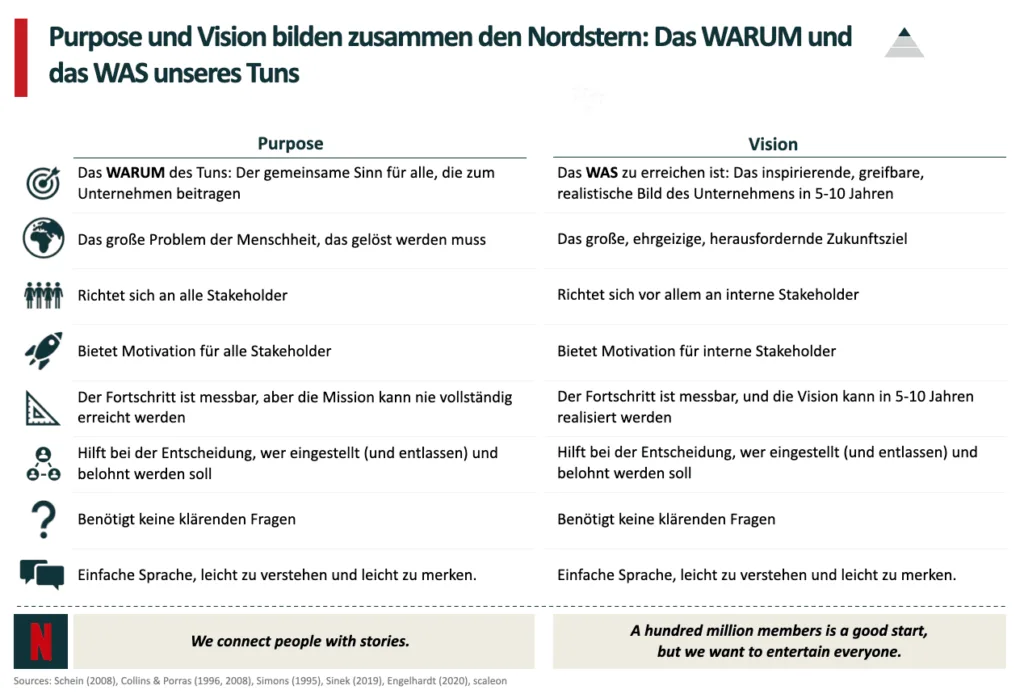
- Mission: why does the company exist, and what is its purpose? The mission describes the operational activity and establishes how the company pursues its goals day to day.
- Vision: what is the company trying to become? The vision is the picture of the company in five to ten years, specific enough that progress towards it can be measured.
- Values: which principles govern behaviour when the mission and the vision leave a decision open? A value earns its place by ruling something out.
An IT services provider might have as its mission: "We enable companies to work more efficiently through innovative software solutions." The vision could read: "We want to become the leading player in the digitalisation of mid-sized companies in Europe." Values such as innovation, customer proximity and sustainability would complete this mission statement.
Where mission statements fail
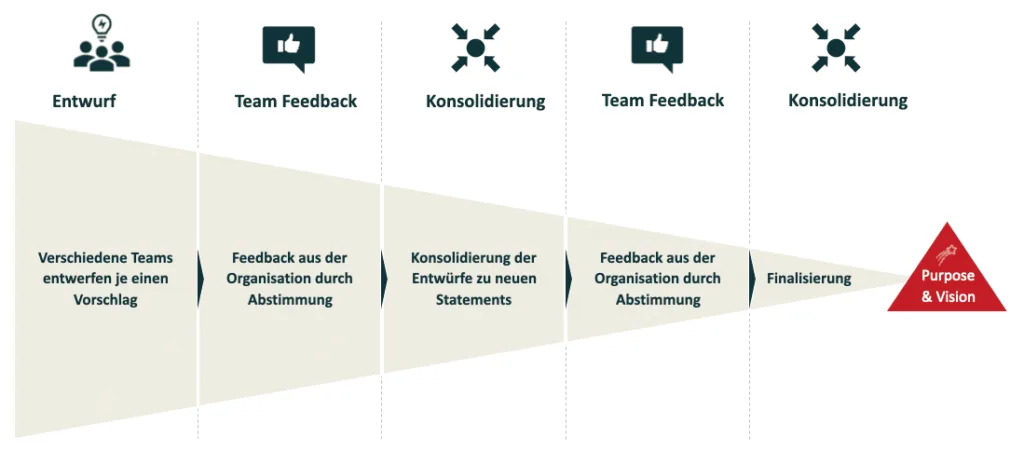
The graphic above sets out one way to run the drafting: several teams each write a competing proposal, the organisation votes on them, the drafts are consolidated into new statements, the organisation votes again, and the result is finalised. Three failure modes account for most of what goes wrong, and each needs a different fix.
1. No agreement on what the statement is for
Without agreement on what the statement has to decide, it gets written to offend nobody. A statement that offends nobody rules nothing out.
Solution: settle first which decisions the statement is meant to settle. A workshop with the relevant stakeholders works, provided it produces that list rather than a word cloud.
2. The statement says one thing, the organisation rewards another
The common version is a value that the organisational structure actively penalises. A company promotes transparency while information is the main source of authority for the people who hold it, or customer proximity while nobody in a customer-facing role can decide anything. Employees read the contradiction accurately and conclude that the statement is decoration.
Solution: for each value, name the decision it is supposed to change and the existing practice it contradicts. Regular feedback conversations and visible internal processes are useful instruments, but they only start working once that contradiction has been named.
3. Written at the top, so read as an announcement
A statement drafted at leadership level and then presented reads as an announcement, and it gets judged on whether it matches what people already experience. Where it does not, it produces resistance rather than identification, because the gap between the text and daily reality is now on record.
Solution: involve employees while the wording is still open. Surveys and workshops both work, and the sequence in the graphic above is designed for exactly this: the organisation votes twice before anything is final.
What separates a statement that gets used
Four properties separate the statements that get used from the ones that get framed.
- Clarity: understandable on first reading, with no jargon and no sentence that needs a clarifying question.
- Relevance: written for everyone it is meant to govern, from employees to customers. Not only for the leadership team that signed it.
- Authenticity: recognisable to someone who works there. The test is whether an employee would use the same words to describe the company to a friend.
- Regular review: market changes and internal developments make statements obsolete. An obsolete statement is worse than none, because it still gets quoted.
Tools for developing the statement
- Simon Sinek's Golden Circle: start with the "why". Then work forward to "how" and "what."
- SWOT analysis: strengths, weaknesses, opportunities and risks, to keep the statement realistic.
- OKR framework: Objectives and Key Results tie the statement to concrete goals in execution.
What a mission statement has to be able to decide
The test is a decision it has already settled. Name one option the company turned down because it did not fit, and one it took for the same reason. If neither example exists a year after publication, the statement is not in use, whatever else is true about it.
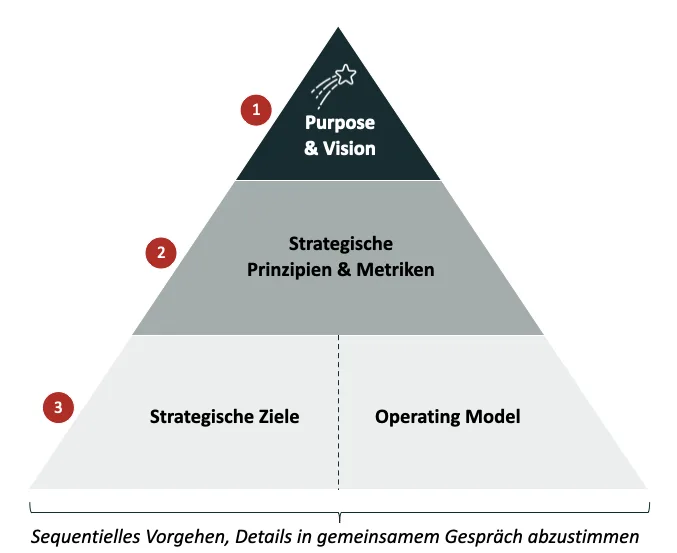
scaleon works with companies on this as the top tier of the pyramid above, before the strategic goals and the operating model below it. If you are starting that work, the useful first question is which decision your current statement fails to settle.
Corporate mission statement: the questions we get asked most
What is a corporate mission statement?
A corporate mission statement is the written form of a company's identity, published so that employees, customers and candidates all read the same version. It has three parts. The mission covers why the company exists, the vision what it intends to become, and the values which behaviour is expected when a decision is not covered by either.
What is the difference between mission, vision and purpose?
Purpose and mission both answer why the company exists, and purpose is the term more often used for the version aimed at every stakeholder rather than at the business itself. Vision answers what is to be reached, within a horizon of roughly five to ten years. The practical consequence is that a purpose outlives every strategy cycle and a vision does not.
How do you develop a corporate mission statement?
Not top-down in a single draft. A workable sequence has several teams write competing proposals, puts them to the organisation for a vote, consolidates the drafts into new statements, votes again, and only then finalises. The votes are the point: they are what makes the result recognisable to the people who have to use it.
Why do mission statements fail?
Three reasons cover most cases. Nobody agreed what the statement was supposed to decide, so it was written to offend nobody. The values contradict what the organisation actually rewards, and employees read that accurately. Or it was drafted at the top and presented, which turns it into an announcement to be judged rather than a commitment to be used.
How do you measure progress towards a vision?
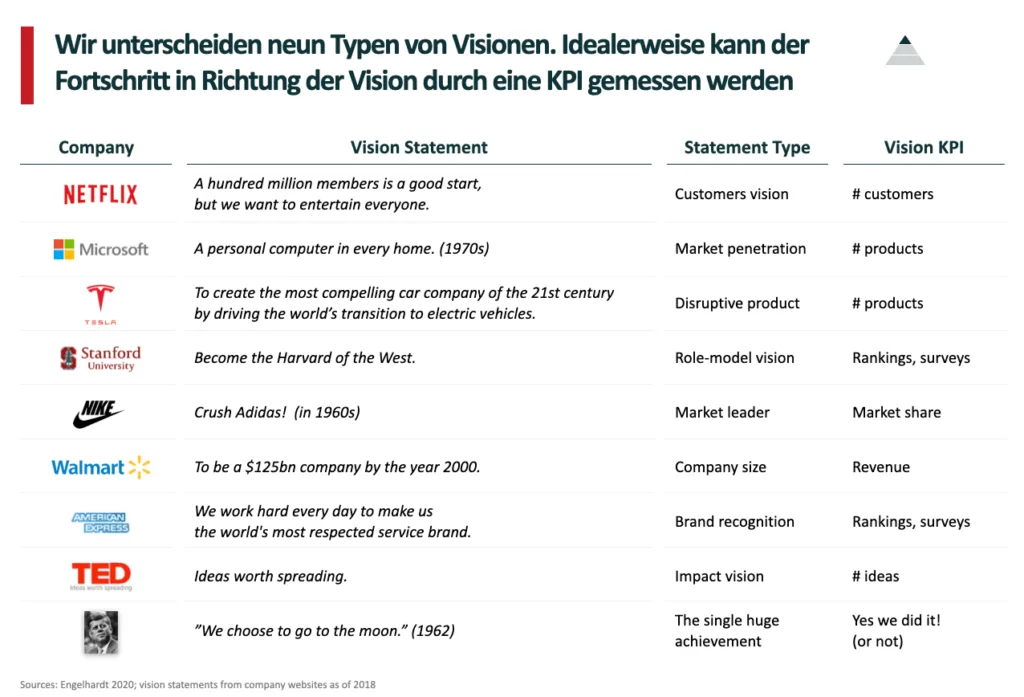
By choosing a vision type that has a natural metric behind it. A vision aimed at customer reach measures customer numbers, one aimed at market leadership measures market share, one aimed at company size measures revenue, one aimed at reputation measures rankings and survey results. A vision with no candidate metric is usually a value in disguise.