


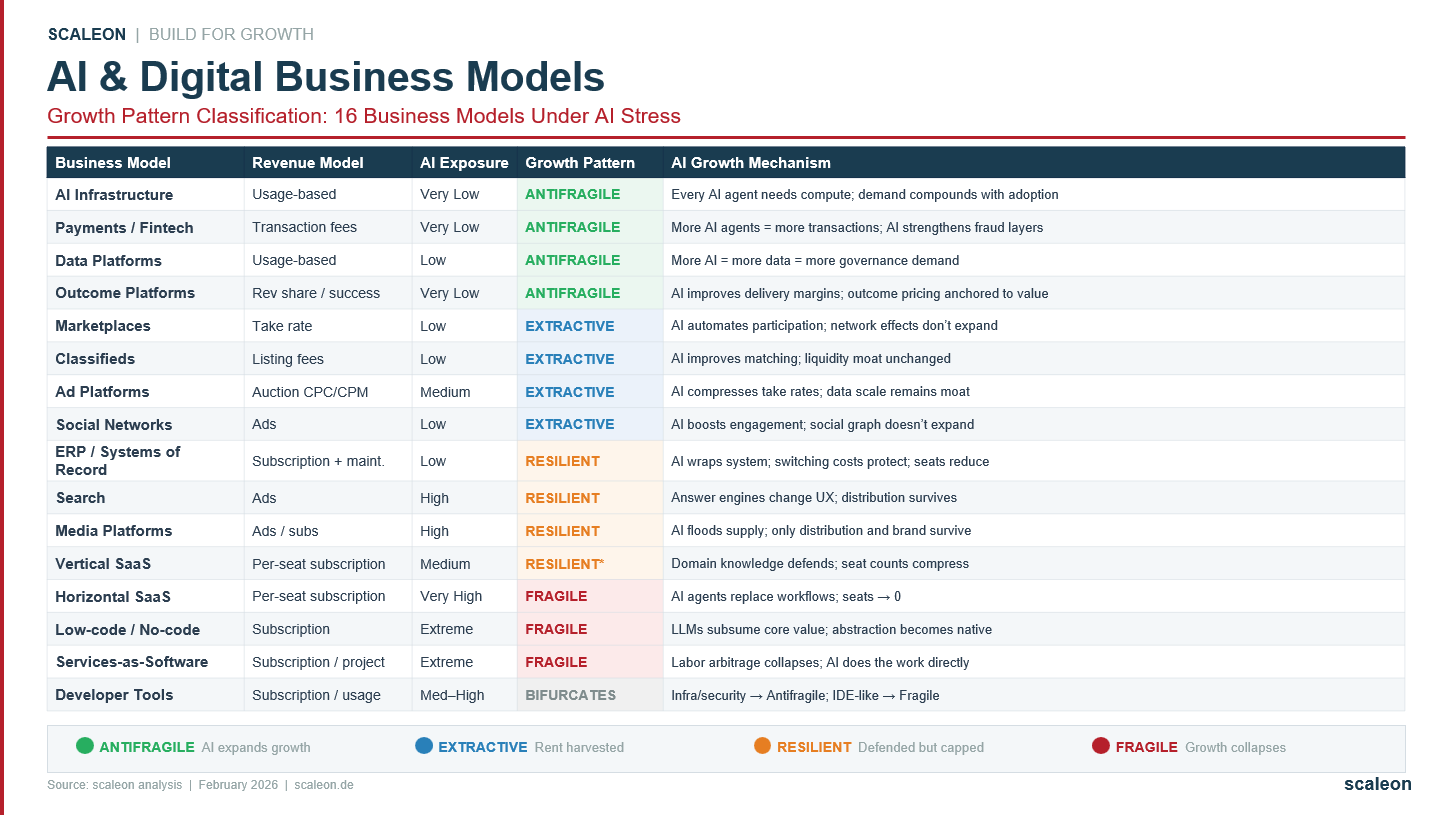
The precise question about AI and strategy is not which industries are at risk, but what AI does to a business’s growth mechanism: its fundamental economics rather than its products or its workforce. That is what determines whether revenue compounds, plateaus, or collapses under AI pressure. We've mapped 16 business model archetypes across four patterns. The pattern a business falls into is not a function of how exposed it is to AI. It's a function of whether it has a self-reinforcing growth core, and what AI does to that core.
Four Patterns
Antifragile. The business has a compounding asset, and AI makes that asset compound faster. More AI usage generates more demand, which deepens the moat. Data platforms are the clearest example: more AI usage creates more data, which creates more governance, quality, and lineage demand. The competitive position strengthens as AI scales.
Extractive. Network effects or scale exist, but AI doesn't expand them, it extracts from them more efficiently. Marketplaces become better at matching, but the network doesn't grow because of it. Ad platforms get better targeting, but the advertiser base doesn't expand. Growth is real. It is also non-compounding. Marginal returns flatten.
Resilient. Lock-in protects revenue, but AI caps the upside by commoditizing parts of the stack. ERP systems stay embedded, switching costs remain high, but fewer users are needed to operate them. The business survives. It doesn't strengthen.
Fragile. No compounding asset exists, and AI replaces the unit of demand directly. Per-seat SaaS is the cleanest case: AI agents replace workflows, seats go to zero, and there is no counterforce. The same logic applies to low-code platforms, where LLMs do natively what the platform abstracts, and to services-as-software, where the labor arbitrage that creates the revenue collapses first.
Strategic Implications by Pattern
The pattern determines what the right move actually is. Getting this wrong, optimizing when you should be scaling, or defending when you should be pivoting, is where value gets destroyed.
Antifragile: scale aggressively. AI stress amplifies the compounding asset. The strategic imperative is to invest in capacity, expand the addressable market, and capture compounding demand. This is not a defensive position. It is a race.
Extractive: optimize the moat. Deepen liquidity, improve AI-driven matching efficiency, defend existing network density. Growth is real but has a ceiling. Marginal returns will flatten; the goal is to extract well before they do.
Resilient: shift to durability. Maximize integration depth, shift pricing toward outcomes, accept lower multiples. The business survives AI pressure but doesn't strengthen under it. The question is how much runway the lock-in buys, and whether that runway is being used to build something more durable.
Fragile: transform the revenue model. The window is 12 to 24 months. This is not optimization. The value proposition itself needs to be rebuilt. Businesses that treat this as a pricing problem or a product iteration will run out of time.
What This Means in Practice
The pattern a business falls into is not destiny. Antifragile businesses can mismanage their advantage. Fragile businesses have transformed before. But the pattern sets the clock and the direction of pressure.
The questions worth asking are structural, not operational:
- Does the business have a self-reinforcing growth core, something that gets stronger as it scales?
- Does AI expand that core, extract from it, cap it, or remove it?
- Is the current strategy calibrated to that reality, or to a version of the business that no longer exists?
Most strategic conversations about AI start with exposure. The more useful starting point is growth architecture.