

The OKR Impact Report 2022 asked 40 companies and executives across Europe what OKRs actually changed for them. 87% say the framework met or exceeded their expectations, 98% report better transparency around goals and performance, and 90% report better communication and better strategy execution. The study was produced by scaleon and Mooncamp.
Berlin/Cologne, 23 November 2022. OKRs give companies a single goal-setting method that holds across very different contexts, from company and divisional goals through to QBR processes in product organisations. Adoption is broad. According to Google Trends, search queries for OKRs have increased twelvefold over the past 20 years, and Google, Zalando, Amazon, BMW, Microsoft and Uber all use the framework. The full study, “OKR Impact Report 2022 - Perspectives on the design, use, and impact of OKRs”, is available below.

"In today's volatile and dynamic markets, shaped by recession, inflation, innovation pressure, and trends such as digitalisation, Industry 4.0, and big data, companies must be able to adapt quickly to changing conditions in order to remain competitive in the future," says Stefan Benndorf, co-founder of scaleon. "More and more companies are turning to flexible and agile structures with short decision-making paths. OKRs are a very suitable instrument for this."
"We are witnessing first-hand how OKRs are making their way into every industry. Mooncamp's customer base looks like a cross-section of our entire economy, from NGOs and schools to DAX corporations and tech startups, football clubs and the mid-sized company next door. Everyone is using OKRs. OKRs are no longer a hype. They are an established part of the repertoire of how modern organisations are led," says Joel Schneider, co-founder of Mooncamp.
Objectives and Key Results, or OKRs for short, are a management and goal-setting system that connects qualitative goals (objectives) with measurable key results at all organisational levels of a company. The aim of the OKR method is to translate the long-term strategy of a company into shorter-term OKRs and to do so in as transparent a manner as possible. 70% of the executives surveyed stated that they use OKRs in quarterly cycles. 80% rely on the role of an OKR master to oversee and further develop the process.
OKRs enter the company through the executive layer
OKRs are a top management topic. The motivation is better corporate management with optimised prioritisation, transparency, and strategic alignment between employees and teams. Both the mandate for introduction and the goal-setting behind an OKR framework come from the executive and board level in 90% of cases.
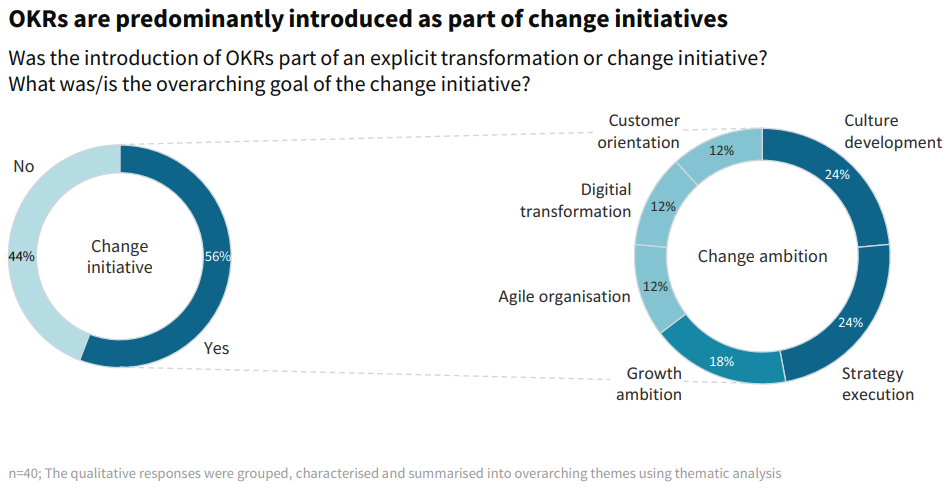
56% of companies implement OKRs explicitly in the context of a change or transformation initiative. The change ambitions split six ways: culture development and strategy execution each account for 24%, growth ambition for 18%, and agile organisation, digital transformation and customer orientation for 12% each.
"I would recommend introducing OKRs to any company that wants to create a culture in which employees have a say and is willing to invest sufficient time for this," says the CEO of a technology company.
What impact do OKRs have?
83% of decision-makers state that OKRs have had a positive impact in their company. In 87% of all companies, expectations of OKRs were met or even exceeded.
The categories with the highest reported impact from the use of OKRs are transparency around goals and performance, cited by 98% of companies, followed by improved communication and strategy execution, each cited by 90% of companies.
"It is the best framework I know for efficiently aligning complex organisations toward a common goal," says the CEO of a mid-sized company.
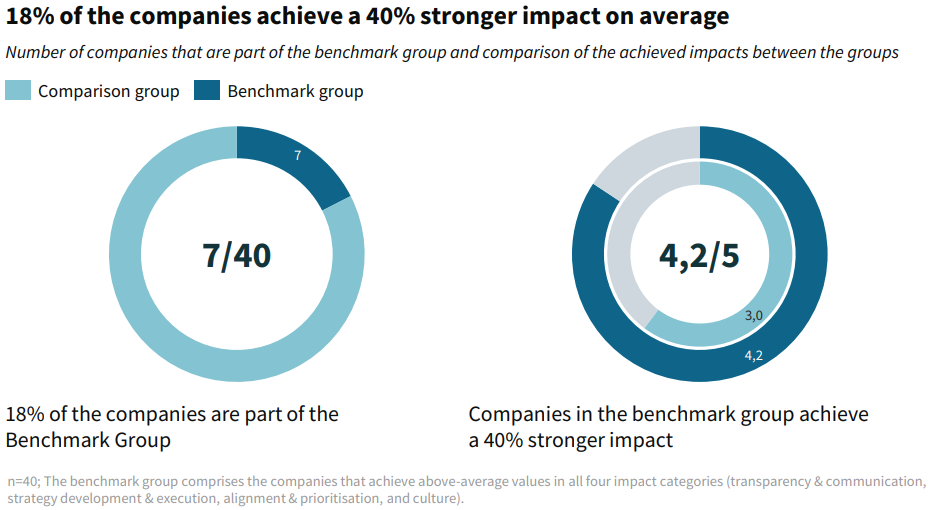
Around 18% of companies achieved an impact through OKRs that was 40% higher than the rest. The benchmark group is defined across four categories: transparency and communication, strategy development and execution, alignment and prioritisation, and culture. Two factors explain the gap:
- The anchoring of the OKR system is particularly strongly embedded in the cultural DNA of the company. This cultural DNA can be traced back to the fact that these companies use the corporate strategy and further strategic instruments such as vision and purpose as important reference points for their OKRs. It stands to reason that a strong alignment of the OKR system with the corporate strategy supports the achievable impact here.
- These companies have a 25% higher communication intensity, measured by the number of communication channels used, as well as a significantly higher frequency of OKR check-ins compared to the reference group. Communication therefore appears to be one of the key factors in maximising the impact of OKRs.
What decision-makers found hardest: the introduction, and keeping the system relevant
Two topics are described by the decision-makers surveyed as particularly challenging.
- Introducing OKRs is a change management challenge. Companies state that one success factor lies in a clean process and the anchoring of the methodology. Top management must take the topic seriously and provide sufficient attention and resources for the introduction to succeed.
- OKRs are not a one-time project, and most companies plan to continue developing their OKR system systematically. This includes above all increasing the relevance of the OKR system for the organisation and aligning it even more strongly with top priorities, strengthening learning loops, and improving methodological and process capabilities.
How the study was conducted
scaleon and Mooncamp surveyed executives from 40 companies in order to obtain a decision-maker perspective on the design, use, and impact of OKR systems: how companies work with OKRs, how they communicate about them internally, what impact OKRs have, and what challenges they bring. The companies surveyed are based across Europe and cover all company sizes, from startups and mid-sized companies through to large corporations. The companies surveyed represent the industries of IT, finance, industrial goods, communications, energy, consumer staples and discretionary goods, real estate, and materials.
The OKR questions we get asked most about this study
What does the OKR Impact Report 2022 say about whether OKRs work?
83% of the decision-makers surveyed reported a positive impact in their company, and in 87% of companies expectations of OKRs were met or exceeded. Impact was rated highest for transparency around goals and performance, at 98%. The study rests on 40 companies of all sizes, from startups to large corporations.
Who decides to introduce OKRs?
In 90% of cases the mandate and the goals behind the OKR framework come from executive or board level. Just over half of the companies surveyed, 56%, introduced OKRs explicitly as part of a change or transformation initiative, most often to strengthen culture or advance strategy execution, each cited by 24% of respondents.
What separates the companies that get the most out of OKRs?
18% of the companies surveyed, 7 of 40, reach an average impact score of 4.2 out of 5 against 3.0 for the rest, a 40% stronger impact. Two things distinguish them. They anchor their OKRs in the corporate strategy, vision and purpose, and they run 25% higher communication intensity with more frequent check-ins.
How do companies run their OKR cycles?
70% of the executives surveyed use quarterly cycles. 80% rely on an OKR master to oversee and further develop the process. The benchmark group holds check-ins noticeably more often than the comparison group, which the study identifies as one of the two factors behind their stronger impact.
What is the hardest part of introducing OKRs?
Change management. The stated success factors are a clean process and firm anchoring of the methodology, and both require top management to allocate real attention and resources. The second challenge is continuity: most companies plan to keep developing the system, sharpening its alignment with top priorities and strengthening learning loops.
About scaleon
scaleon is a boutique consultancy focused on strategy and strategy execution with extensive expertise in the design and roll-out of OKR systems. scaleon was founded by experienced entrepreneurs and senior managers Stefan Benndorf and Dr. Philipp Engelhardt, driven by a passion for working in fast-moving, dynamic, and challenging business environments and solving complex strategic problems for their clients. Clients include well-known technology companies, mid-sized businesses, and large corporations. In 2022, scaleon was recognised with the prestigious Top Consultant Award.
Learn more at scaleon.com
About Mooncamp
Mooncamp is the leading strategy operating system for OKRs, supporting organisations in building a culture around transparency and focus and developing high-performing teams.
Mooncamp was founded on the conviction that software should adapt to the individual needs and processes of each company - not the other way around. For this reason, Mooncamp is the most flexible software on the market, allowing organisations to customise every aspect of their OKR system, with simplicity and ease of use always at the centre.
Mooncamp is equally popular with small and large organisations. Today, around 5,000 teams from all parts of the world rely on Mooncamp to strengthen their OKR processes and execute their strategy, including fast-growing tech companies such as Tinder and large corporations from all industries.
Learn more at mooncamp.com