

In today's globally networked economy, companies of all sizes are increasingly required to implement agile business models in order to meet dynamic market conditions. Quarterly Business Reviews (QBRs) offer a structured method for regularly reviewing and adjusting the strategic direction of a company. In combination with Objectives and Key Results (OKRs), QBRs can bridge the gap between long-term strategy and short-term operational business by providing a clear and structured approach. This enables companies to optimise their strategy execution and adapt quickly to change.
Agile strategy execution through QBRs
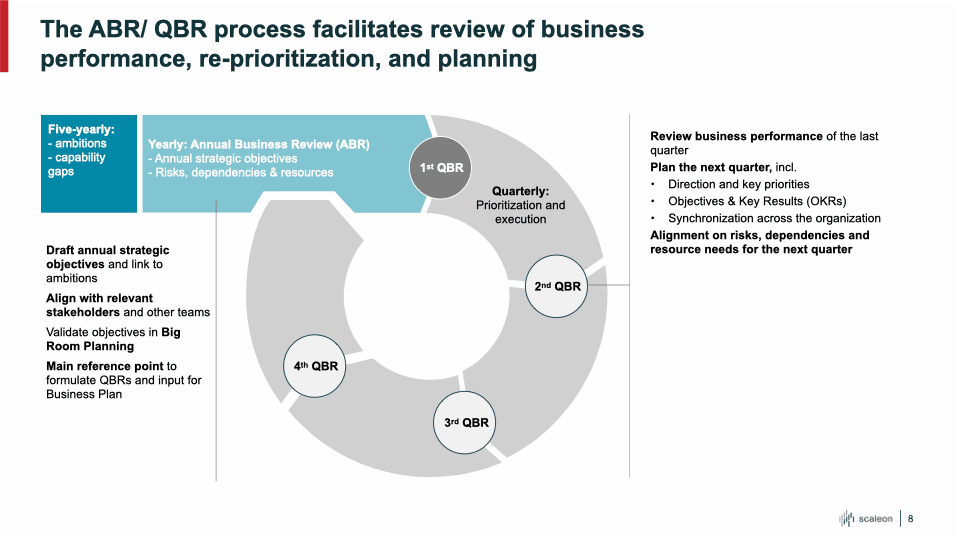
QBRs are a key instrument for agile strategy execution, as they help companies regularly review and adjust their goals. In a constantly changing business environment, linear, long-term-oriented strategy approaches are often no longer sufficient. Agile concepts such as QBRs enable companies to respond flexibly to market changes and use their resources efficiently. By integrating QBRs into the strategic process, companies can define their goals more clearly, increase transparency, and distribute responsibility across all organisational levels.
This not only relieves pressure on company leadership, but also actively involves every employee in the achievement of strategic goals, which can contribute to more realistic prioritisation and new impulses. For the transformation from rigid, hierarchical corporate structures toward an agile and flexible business model to succeed, however, a change of mind at the leadership level and the introduction of corresponding strategy models alone are not sufficient. Only a comprehensive cultural shift across the entire company is sustainably promising in this context.
Typical challenges in strategy execution
Many companies face challenges such as an unclear vision and mission, a focus on output rather than outcome, insufficient transparency of goals, and inefficient resource allocation. These problems can impede the successful execution of the corporate strategy. QBRs can address these challenges by bringing clarity and rigour to the strategic process. They help to clarify the vision and mission of the company and ensure that all employees understand the strategic goals and integrate them into their daily work.
Mission and vision as anchor
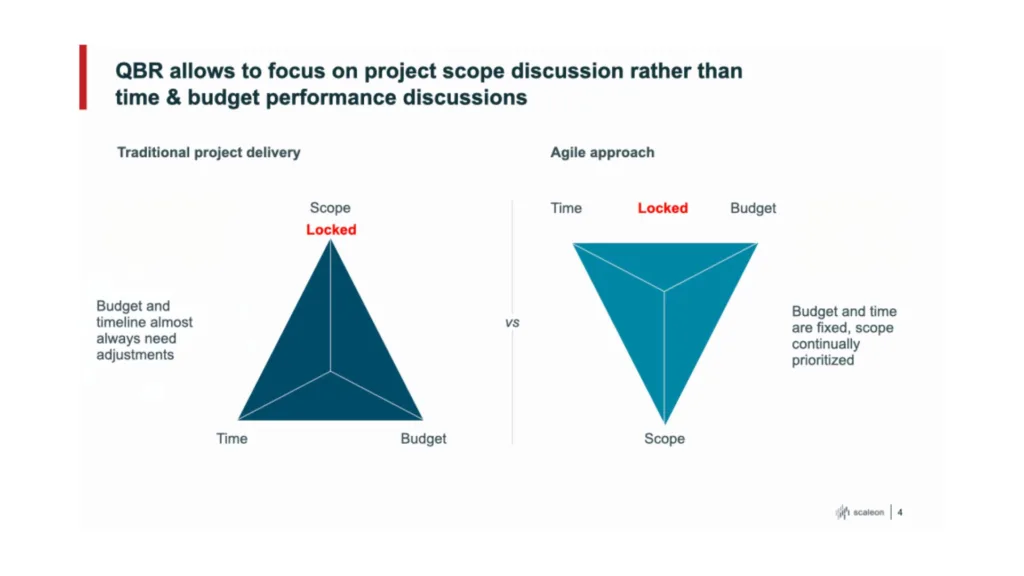
A clear corporate vision and mission are essential for successful strategy execution. The vision describes an ambitious picture of the company's future, while the mission defines the purpose and reason for the company's existence. These anchor points give employees a clear mandate and answer the question of the company's purpose. QBRs support this by regularly bringing the vision and mission into focus and ensuring that all strategic decisions are aligned with them. This promotes employee motivation and identification with the company and its goals.
Outcome vs. Output
A further problem in strategic alignment is the focus on output rather than outcome. While output describes quantifiable, measurable results, such as the number of products sold, outcome describes the qualitative benefit or value created for the target group. QBRs help to shift the focus toward outcome by ensuring that strategic goals take into account not only quantitative but also qualitative aspects. This promotes a stronger connection between corporate goals and the actual benefit delivered to customers.
Insufficient transparency and prioritisation
Transparency and clear prioritisation are essential to ensure that all employees are working in the same direction. QBRs promote this transparency by communicating goals and progress clearly and ensuring that every employee understands how their work contributes to achieving the corporate goals. This prevents counterproductive movement within the company and ensures that resources are used efficiently.
Lack of expertise
Successful strategy execution requires the right skills and tools. QBRs support the identification and development of the necessary specialist expertise within the company. Through the regular review of goals and progress within the QBR framework, companies can ensure that their employees have the skills required to achieve the strategic goals.
QBR as a multidimensional approach to strategic goal achievement
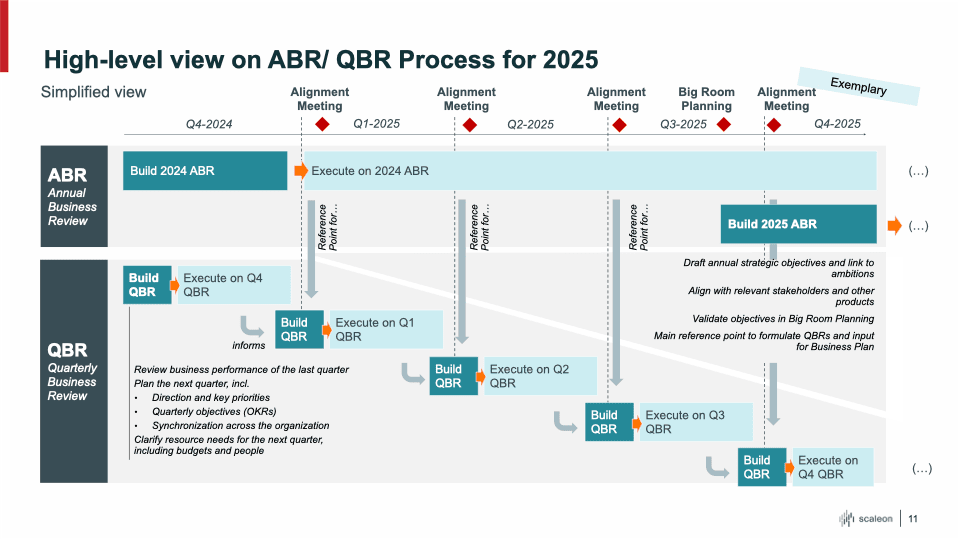
QBRs offer a comprehensive approach to strategic goal achievement by supporting the structuring, classification, and prioritisation of initiatives, projects, and measures. They help to view the totality of all company activities and prioritise them according to their importance. This enables more efficient resource allocation and a clear focus on the most important goals. In addition, QBRs promote the alignment of goals across different organisational levels by ensuring that all employees understand how their work contributes to achieving the corporate goals.
Structuring and prioritisation
QBRs help to view the totality of all initiatives, projects, and measures within the company and prioritise them according to their importance. This enables more efficient resource allocation and a clear focus on the most important goals.
Alignment of goals
The structured approach of QBRs facilitates the breakdown of strategic goals to subordinate levels such as departments and teams. This ensures that all employees understand how their work contributes to achieving the corporate goals. Through the clear communication of goals and progress within the QBR framework, companies can ensure that all employees are working in the same direction and that resources are used efficiently.
QBRs support the communication of corporate goals
QBRs offer a structured means of communicating corporate goals both internally and externally. This promotes transparency and understanding of the company's strategic direction.
Agile concept of strategy execution
A QBR process installed at company level enables a more agile adaptation of the corporate strategy to changing conditions. This is essential for remaining competitive in dynamic markets.
OKRs and QBRs: a powerful combination
The combination of QBRs and OKRs offers a powerful means of achieving the strategic goals of a company. OKRs help to break down strategic goals into smaller, actionable components, while QBRs structure the overall organisational strategy process.
Involving all employees
The OKR concept promotes the involvement of all employees in the achievement of strategic goals. This increases employee motivation and identification with the company and its goals.
Combining QBRs and OKRs
The combination of QBRs and OKRs enables companies to review and adjust their strategy on a regular basis. This promotes agile and flexible strategy execution.
The QBR effect: a cost-benefit analysis
Integrating QBRs into the corporate structure can generate lasting benefit. They promote transparency and prioritisation of goals and enable more efficient resource allocation.
Benefits of QBRs
QBRs help to place the strategic direction of a company on the agenda on a regular basis. This promotes transparency and tangibility of goals at all levels of the company.
Costs of QBRs
Introducing QBRs initially requires additional work and resources. In the long term, however, the benefits can outweigh the initial costs.
Success factors for the successful introduction of QBRs
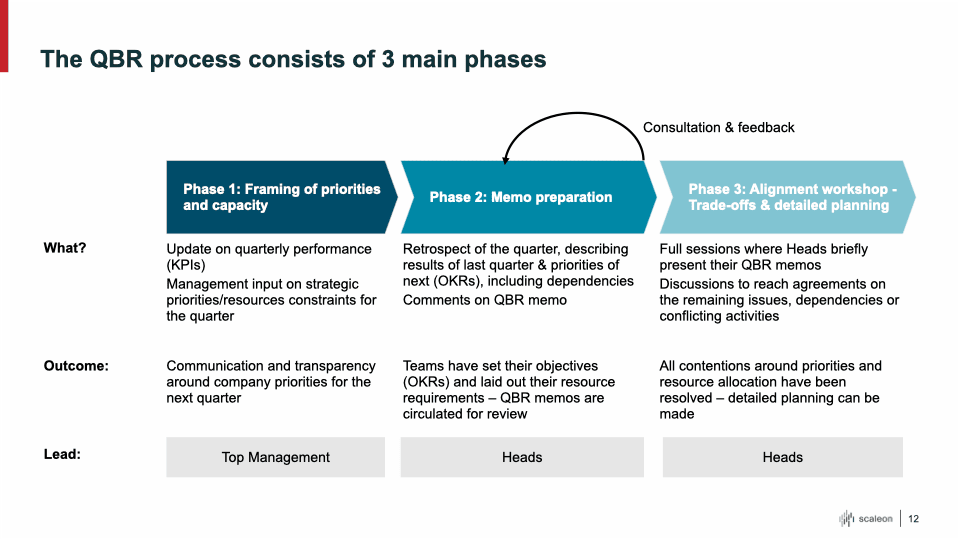
For a successful introduction of QBRs, the current strategy execution process must be analysed and weaknesses identified. A clear goal-setting and the involvement of all employees are essential.
Common weaknesses
Common weaknesses in the goal achievement process include insufficient transparency, imprecise goal specifications, and inefficient resource allocation. QBRs can address these problems by bringing clarity and rigour to the strategic process.
Individual design of the QBR
The design of QBRs must be adapted to the specific requirements and structures of the company. This ensures that QBRs can be implemented sustainably and successfully.
Guide to introducing QBRs
For the introduction of QBRs, a sequential approach has proven effective. This includes the clear definition of the goal specification, an assessment of the status quo, and the design of a pilot.
Clearly defining the goal
The goal specification for the introduction of QBRs must be clearly formulated. This describes the added value that QBRs generate compared to the existing status quo.
Stocktaking and identification of opportunities and risks
The individual parties involved in the execution of the corporate strategy must be consulted. This helps to identify potential challenges and opportunities.
Design of a goal system
Building on the insights gained, a suitable organisational and process structure is developed. This includes the corresponding processes and operational tools.
Revision of the strategic reference framework
The strategic framework conditions must be established in order to implement QBRs as an agile management instrument. This concerns both the overall strategic direction and the organisational and hierarchical structure.
Design and execution of a pilot
A pilot project helps to test and validate the QBRs. This ensures that the process can be continuously improved.
Follow-up and implementation
Following the conclusion of the pilot phase, a structured review of the insights gained takes place. These are then presented, discussed, and evaluated. The finalised goal system is gradually integrated into actual business operations.
Three questions before you introduce QBRs
The value of a QBR does not come from the meeting. It comes from what the company is forced to make explicit in order to hold one. Three questions worth answering before the first cycle is planned:
- Can every team name the corporate goal their current work pays into, without looking it up
- Do your goals describe an output you can count, or an outcome a customer would notice
- When a priority changes mid-quarter, who decides what gets dropped, and how do the affected teams find out
Where two of the three have no clear answer, the QBR process is not a reporting problem. It is the instrument that produces the answers.
Quarterly Business Review: the questions we get asked most
What is a Quarterly Business Review (QBR)?
A QBR is a structured quarterly review in which a company checks its strategic direction against what actually happened and adjusts it. It sits between the annual strategy cycle and day-to-day operations, and it covers the whole portfolio of initiatives rather than a single project.
What is the difference between a QBR and an OKR cycle?
OKRs break strategic goals down into smaller components that teams can act on. The QBR structures the strategy process around them: which initiatives exist, how they rank against each other, and which resources they get. OKRs work without a QBR, and a QBR works without OKRs, but the combination is what connects a team goal to a company goal.
What is discussed in a QBR meeting?
Three things. The status of the current goals against evidence rather than against intent. The ranking of all initiatives, projects and measures by their contribution to the strategy. And the resource decision that follows from that ranking, including what stops.
How is a QBR process introduced?
In sequence: define what the QBR is meant to improve over the current status quo, take stock with the people who already carry strategy execution, design the goal system and the process around it, set the strategic reference framework, then run a pilot in one unit before rolling it out. The pilot decides the pace, not a fixed timeline.