


Background
Elia Group, a leading European electricity grid operator with subsidiaries in Belgium and Germany, operates an internal digital incubator called "The NEST." This incubator evaluates more than 25 potential candidates for digital initiatives each year and develops selected ideas into market-ready Minimum Viable Products (MVPs). Elia Group approached scaleon with a central challenge: how can the value contribution of early digital innovations be assessed in a transparent and comprehensible manner?
This white paper uses the example of Elia Group to show how the value contribution of early digital innovations can be assessed in a transparent and comprehensible manner.

Challenge
Three central fields of action were identified during the analysis of the situation:
- Heterogeneous project landscape: The NEST team must evaluate a portfolio of highly diverse digital ideas, each with its own goals, resource requirements, and potential impact.
- Uncertainty and intangible benefits: Many early digital innovations generate value that does not immediately translate into financial metrics.
- Fragmented evaluation process: There was no end-to-end assessment approach that covered both the pre-selection of promising ideas and the subsequent measurement of success.
Traditional ROI models proved unsuitable for these early-stage innovation projects. Assessment was based predominantly on subjective judgements, with limited quantification and insufficient retrospective validation. This made it difficult both to select the most promising ideas and to demonstrate the long-term value contribution of the incubator programme.
Solution: The N-ROI approach

In close collaboration with the client, scaleon developed the "N-ROI" approach (NEST Return on Investment), a five-step framework for the comprehensive evaluation of innovation initiatives:
- Initial Checklist: An efficient screening process with defined criteria such as market demand, strategic alignment, and user potential, to filter out unsuitable ideas at an early stage.
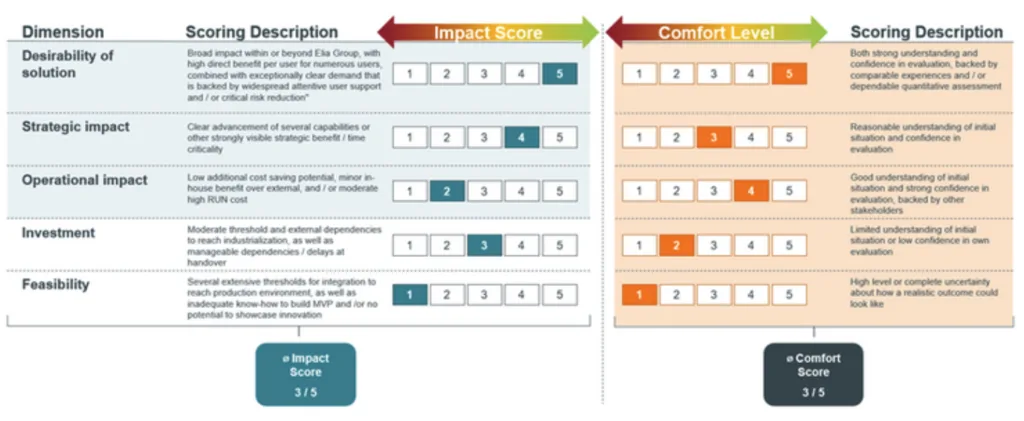
- N-ROI Scoring Model: A structured evaluation across five core areas (desirability, strategic impact, operational impact, investment requirements, and feasibility) using a dual scale that captures both impact and assessment confidence.
- NEST Prototyping Phase: Development of a Minimum Viable Solution to validate assumptions and identify areas for improvement before full implementation.
- Post-NEST Validation: Re-evaluation after implementation and creation of a standardised business case to document the benefits actually realised.
- N-ROI Cohort Analysis: Aggregation of individual project results into an overall portfolio assessment, comparing the cumulative net benefit against total effort.
Implementation
The implementation takes place in three phases:
- Analysis of existing approaches: The consulting team examined the existing innovation process and analysed previous projects to identify patterns of successful and failed initiatives.
- Development of the ROI framework: Based on industry standards and specific requirements, scaleon developed a tailored ROI model that accounts for both quantitative and qualitative factors.
- Retrospective testing and optimisation: The framework was tested on selected projects and iteratively refined to ensure practicability and alignment with operational reality.
Impact
The implementation of the N-ROI approach developed by scaleon highlights the following potentials:
- Accelerated decision-making: Through the structured pre-screening process, the time from idea submission to decision can be significantly reduced.
- Increased transparency: The standardised evaluation enables objective comparisons across highly diverse innovation initiatives.
- Improved resource allocation: By identifying non-promising initiatives early, resources can be deployed more purposefully.
- Demonstrable value: The portfolio analysis provides a solid basis for evidencing the overall value contribution.
- Cultural shift: The N-ROI approach fosters a culture of "disciplined innovation" that combines creativity with systematic evaluation.
Lessons Learned
Key insights that are also relevant for other organisations:
- Balance is essential: A successful innovation evaluation process must be sufficiently rigorous to enable well-founded decisions, yet agile enough not to stifle the spirit of innovation.
- Multi-dimensional perspective: Evaluating early digital initiatives requires consideration of both quantitative and qualitative factors.
- Continuous evaluation: Innovation projects should not only be assessed at the beginning and end, but continuously throughout their entire lifecycle.
- Learning orientation: The N-ROI approach serves not only as a project selection tool, but also creates a structured framework for organisational learning from both successes and failures.
The N-ROI approach demonstrates how organisations can systematically capture and manage the elusive value of early digital innovations. In a world increasingly shaped by digital transformation, this capability is becoming a decisive competitive advantage.