
Customer lifetime value (CLV) is the total margin a customer generates over their entire relationship with you. The margin-adjusted method is the only version you can actually spend against: for a SaaS company with $24K annual revenue per account, 80% gross margin, and a 3-year average lifespan, CLV is $24,000 x 0.80 x 3 = $57,600. Skip the margin step and you overstate it by around 30%.
Key takeaways
- The reliable CLV formula is Average Revenue per Account x Gross Margin % x Average Customer Lifespan. The margin term is the one most companies drop.
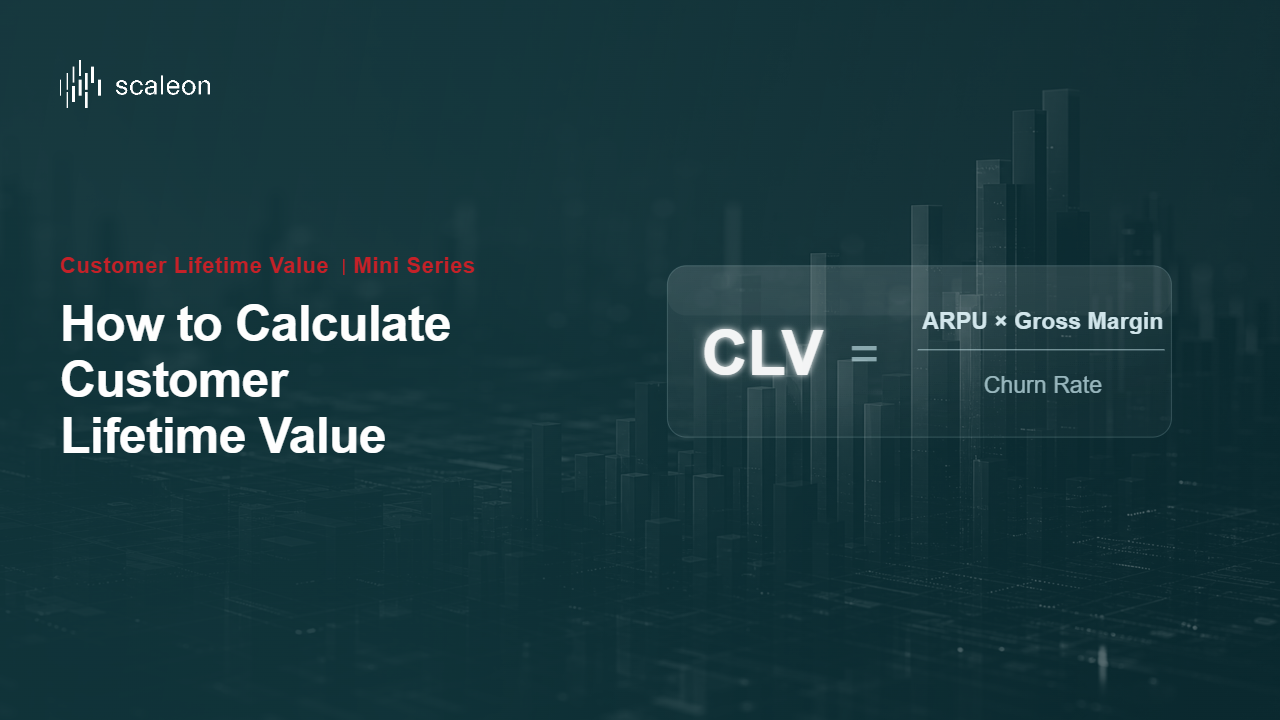
- SaaS teams use a churn-rate variant: CLV = ARPA x Gross Margin ÷ Monthly Churn Rate. It is mathematically equivalent but easier to update as churn moves.
- Five different methods produce five different answers from the same data. Omitting the margin adjustment alone overstates CLV by around 30% (Foundry CRO 2026).
- Average lifespan comes from your churn rate or retention curve, not from assumption. A wrong lifespan distorts CLV more than any other input.
What is the formula for customer lifetime value?
The CLV formula is straightforward: CLV = Average Revenue per Account x Gross Margin % x Average Customer Lifespan
Worked example: a SaaS account paying $24,000 a year at 80% gross margin staying an average of three years has a CLV of $57,600. Average lifespan is derived, not assumed: at its simplest, it is 1 divided by your churn rate. 20% annual churn implies a 5-year average lifespan. More accurately, it comes from the flattening point of your cohort retention curve.
The SaaS variant: CLV using churn rate directly
For subscription businesses, restating the formula in churn-rate terms is often more practical because churn is updated monthly:
CLV = ARPA x Gross Margin % ÷ Monthly Churn Rate
Example: $2,000 ARPA per month, 80% gross margin, 2% monthly churn gives CLV = $2,000 x 0.80 ÷ 0.02 = $80,000. This variant is mathematically equivalent to the lifespan method, because average lifespan in months equals 1 ÷ monthly churn rate, but it updates automatically when you change the churn assumption. Use it for sensitivity scenarios (Paddle, 2025).
Why do different CLV methods give different answers?
- Revenue vs margin-based: margin-based is ~30% lower and correct. Always use margin for spend decisions.
- Simple vs discounted: discounting lowers CLV for long lifespans. Use discounting for multi-year horizons above 3 years.
- Historic vs predictive: predictive uses cohort decay and is more accurate. Use it once you have at least 4 cohort periods of data.
- Capped vs uncapped lifespan: capping avoids inflated long-tail value. Cap at a defensible horizon, 3 to 5 years for B2B SaaS.
The same customer can show $2,000 or $1,400 depending purely on method (Foundry CRO 2026). This is why a CLV number is only meaningful when the method is stated.
How do you avoid overstating CLV?
The three guardrails are margin, lifespan, and a capped horizon. Always adjust for gross margin. Derive lifespan from real retention data. Cap the horizon at three to five years.
The size of the margin gap is easy to underestimate. In a scaleon CLV model for a digital subscription business, the revenue-based lifetime value for the 2025 cohort came to roughly €1,900, while the margin-adjusted figure (contribution margin) was around €560, a 3.4x difference from the same underlying customers. Quoting the revenue number would have justified more than three times the defensible acquisition spend. The margin adjustment is not a refinement, it is the difference between a number you can spend against and one that will mislead every decision built on it.
What CLV benchmarks should you compare against?
CLV only becomes actionable when measured against acquisition cost. The standard health check across B2B SaaS is the LTV:CAC ratio, anchored at 3:1 or higher for mature businesses (HubSpot, 2025; For Entrepreneurs, 2023). Ranges by stage:
- Early-stage (pre-PMF): 1:1 to 2:1 is common while acquisition and retention are still being tuned.
- Growth-stage B2B SaaS: 3:1 is the widely cited floor for a sustainable model.
- Top-quartile: 5:1 or above, typically companies with strong net revenue retention offsetting high initial CAC.
- CAC payback: under 12 months is the companion benchmark; above 18 months flags a cash-efficiency problem regardless of CLV.
Customer lifetime value: the questions we get asked most
What is the simplest way to calculate CLV?
Multiply average revenue per account by gross margin percentage by average customer lifespan. For a €24K account at 80% margin staying three years, CLV is €57,600. The margin adjustment is essential; using revenue alone overstates the value by around 30%.
What is the SaaS formula for CLV using churn rate?
CLV = ARPA x Gross Margin % ÷ Monthly Churn Rate. At $2,000 ARPA, 80% margin, and 2% monthly churn, CLV is $80,000. This is mathematically equivalent to the lifespan method but easier to update in monthly models, because monthly lifespan equals 1 ÷ monthly churn rate.
How do you find the average customer lifespan?
At its simplest, lifespan is 1 divided by your churn rate, so 20% annual churn implies a 5-year average lifespan. More accurately, derive it from the flattening point of your cohort retention curve, which captures the durable core rather than assuming constant churn.
Why adjust CLV for gross margin?
Because CLV should reflect the value you keep, not the revenue you bill. Omitting margin overstates CLV by around 30% and makes acquisition spend look more justified than it is. A margin-adjusted CLV is the only version safe to use in an LTV:CAC ratio.
What is a good CLV for B2B SaaS?
CLV in isolation tells you little. The relevant test is the LTV:CAC ratio, where 3:1 or higher is healthy for growth-stage B2B SaaS (HubSpot, 2025). A high CLV with an equally high CAC is not a strong business; a 3:1 ratio with a CAC payback under 12 months is.
What to do with your CLV calculation
State your method before you quote a number. Use margin, derive lifespan from real retention data, cap the horizon. Then use the result as a ratio against CAC, segmented rather than blended, because a single company-wide CLV hides the segments where your model actually works. If one segment delivers 4:1 and another 1.5:1, your acquisition strategy should reflect that split.
scaleon helps digital companies calculate, segment, and pressure-test CLV in a way that survives investor scrutiny.
Sources: Foundry CRO (2026); Paddle, “Customer lifetime value explained” (2025); HubSpot, “What is a Good LTV to CAC Ratio?” (2025); For Entrepreneurs, “SaaS Metrics 2.0” (2023).