

Cost efficiency is the relationship between what a company spends and the value that spending produces. An across-the-board cut moves both sides of that relationship at once, which is why cost programmes so reliably deliver a one-off saving and a slower company. Agile cost efficiency attacks only one side: it allocates budget against measured value contribution and revisits the allocation in cycles rather than once a year.
We help you scale your company: Growth strategies with scaleon.
1. Rising cost pressure meets a rigid budget
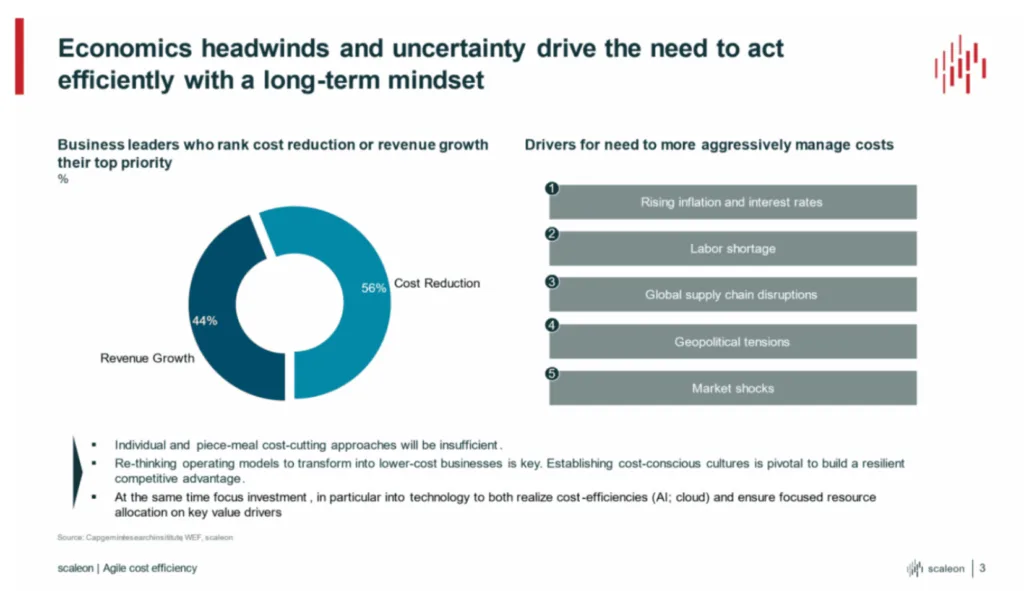
Rising inflation, volatile raw material prices, supply bottlenecks, and geopolitical tensions have raised the cost base and the uncertainty around it at the same time. Cutting into that with a flat percentage target removes cost where it is easiest to remove, not where it is least productive.
EBIT margins vary significantly by industry in Germany. According to an analysis by Gesamtmetall, the return on sales in the metals and electrical industry stood at 2 to 3% in 2022. According to Meyer-Industryresearch, the average EBIT margin of the top 100 companies in German mechanical engineering was 6.7% in 2018. Logistics service providers achieved an average EBIT margin of 3.4%. These differences highlight the need for industry-specific cost efficiency strategies in order to optimise profitability.
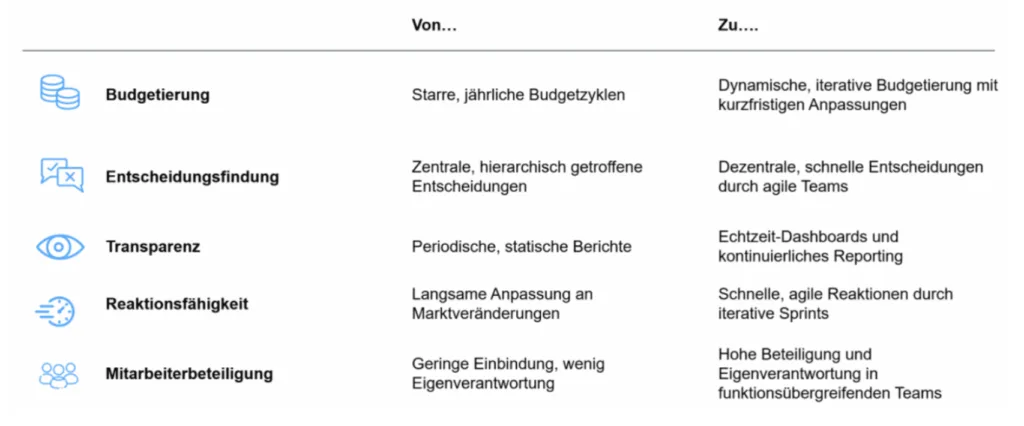
Many companies still run cost management as a rigid target applied at the same rate everywhere. That produces savings in the current year and a weaker company later: budgets get cut where a signature is quickest to obtain, and the investments that would have paid back over several years are the easiest to postpone.
The two approaches differ on four points:
| Traditional Cost Management | Agile Cost Efficiency |
|---|---|
| Rigid budget targets | Flexible budget allocation |
| Focus on short-term savings | Long-term EBIT optimisation |
| Across-the-board cuts in all areas | Value-driven investments |
| Reactive cost-cutting in response to market changes | Proactive, data-based cost management |
The core principles of agile cost efficiency are:
- Dynamic cost control: Rather than fixed budgets, an agile system enables flexible resource allocation that can adapt quickly to market changes.
- Value-driven cost efficiency: Every expenditure is assessed according to its contribution to value creation, making it possible to identify and eliminate unnecessary costs.
- Data-driven decision-making: Through the use of real-time controlling, budgeting tools, and automation solutions, cost reductions can be steered in a targeted manner.
- Iterative optimisation: Agile methods such as sprints and OKRs (Objectives and Key Results) ensure continuous improvement of cost efficiency and prevent inefficient structures from taking hold.
That makes cost efficiency a standing process with an owner rather than a one-time project. A cost structure managed that way can be re-allocated mid-year.
2. How value mapping turns cost cuts into margin
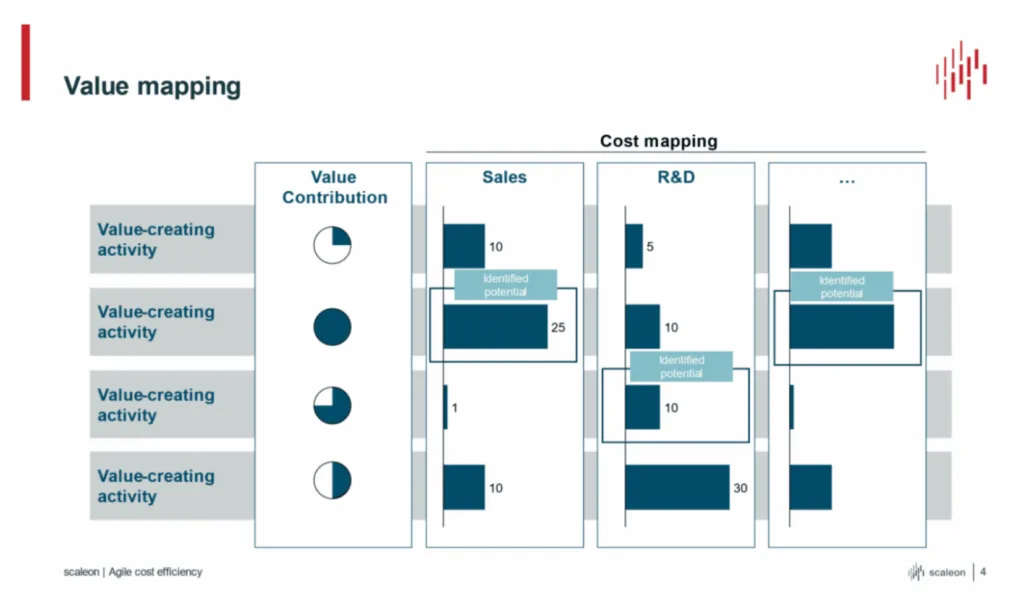
Cost structures are analysed and assigned to their respective value streams, so that each process can be placed on a scale from genuine customer benefit to non-value-adding. The result is a ranking of cost blocks by the value they buy, which is a different list from a ranking by size.
The key principles of value-oriented cost efficiency:
| Principle | Explanation | Example |
|---|---|---|
| Value-based budgeting | Investments are directed specifically into value-creating processes | More budget for high-revenue product lines |
| Dynamic cost optimisation | Adapt budgeting flexibly | Quarterly review of savings potential |
| Automated cost control | Leverage digital dashboards and AI-driven analyses | ERP systems for real-time cost tracking |
| Sustainable EBIT optimisation | Long-term cost strategy instead of short-term savings | Reduction of inefficient processes through automation |
3. Why fixed annual budgets break in a volatile market
Cadence is what the agile part adds. A budget reviewed quarterly can follow a market that moves quarterly, an annual budget cannot.
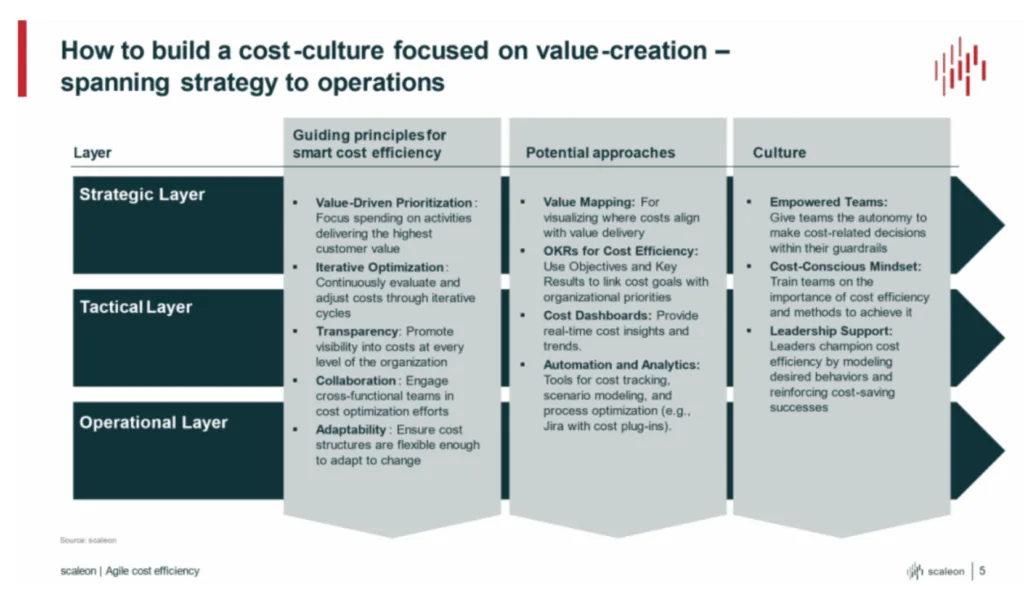
3.1. Three principles for agile cost management
- Iterative work cycles: Through short, regular sprints, budget optimisation measures are tested, evaluated, and adjusted. This allows savings potential to be identified more quickly and implemented effectively.
- OKRs (Objectives and Key Results): Measurable goals that connect financial governance with corporate priorities. This creates a clear link between strategic planning and operational execution.
- Automated dashboards and real-time reporting: Digital controlling tools enable continuous monitoring of budget and cost structure, allowing companies to make well-founded, data-driven decisions.
With that cadence, cost management sits inside the planning rhythm instead of beside it.
3.2. From cost management to EBIT optimisation
Three things have to change in the operating routine for any of this to hold.
- Flexible budgeting: Rather than rigid annual budgets, resources are allocated dynamically. This allows investments to flow precisely where they create the greatest value for the company and the EBIT margin.
- Operational embedding: Cost-saving measures are not isolated projects but an integral part of day-to-day business. Employees are given the authority to make cost decisions independently and to actively integrate cost awareness into their processes.
- Strategic alignment: Financial efficiency and corporate goals must be synchronised. Through precise coordination between controlling, budgeting, and operational execution, the EBIT margin improves without the innovation budget absorbing the cut.
Cost decisions only bite once they are in the planning rhythm. Let us optimise your cost structure together: Strategy execution with scaleon
4. Three levers that move the EBIT margin
- Targeted resource allocation: Capital and budgets are directed where they create the greatest customer benefit and the highest strategic value. That keeps capital available for the next decision.
- Reduction of inefficient expenditure: Through continuous analysis of cost centres, unnecessary or oversized expenses can be eliminated systematically. Digital controlling tools and automated budget analyses help to identify savings potential at an early stage.
- Increase in operational efficiency: An agile corporate culture enables faster responses to market changes. Iterative reviews and real-time reporting keep the improvements coming after the first programme ends.
5. The sequence, from baseline analysis to company-wide roll-out
To optimise costs efficiently and over the long term, companies should follow a structured approach. The following steps provide guidance:
- Baseline analysis:
- Cost optimisation begins with a detailed assessment of the current cost structure and budget utilisation.
- Identification of areas where high costs are associated with low value creation.
- Goal definition:
- Setting clear, measurable goals for improving the EBIT margin.
- Close coordination between the leadership level and operational teams to define strategic ambitions.
- Introduction of agile methods:
- Iterative work cycles (sprints): rapid implementation and review of cost efficiency measures.
- OKRs (Objectives and Key Results): measurable goals that steer the implementation of efficiency improvements in a targeted manner. Learn more about OKR implementation
- Technological support:
- Development of automated dashboards and real-time reporting tools for transparent cost control.
- Use of analysis tools to visualise cost flows and conduct scenario analyses.
- Pilot projects and scaling:
- Starting with pilot projects in selected business units to test and adjust measures.
- Following successful implementation, a step-by-step roll-out across the entire company.
- Continuous improvement:
- Regular reviews and feedback loops to further develop measures dynamically.
- Promotion of a corporate culture that supports transparency and independently responsible cost management.
6. What is the best way to increase efficiency and reduce costs?
The best way to reduce cost is to decide what each euro buys before deciding how much to remove. Companies that skip that step get the saving and pay for it later in innovation capacity.
Lasting cost optimisation rests on three pillars:
- Strategic governance: Structured cost management that aligns savings with corporate growth goals.
- Dynamic budgeting: Flexible resource allocation ensures that investments are made precisely where they create the greatest value.
- Operational efficiency: Digital controlling tools and agile processes enable continuous review and adjustment of the cost structure.
Two questions test whether any of this is in place. Can you name the three cost blocks with the lowest value contribution in your business? And when did the current budget last move between functions mid-year?
Discover how to develop a lasting strategy: Strategy development with scaleon
Cost efficiency: the questions we get asked most
What is cost efficiency?
Cost efficiency is the relationship between what a company spends and the value that spending produces. It improves when the value per euro spent rises, which can happen through lower spend, higher value, or a reallocation from low-value to high-value activities. That third route is the one a flat cost-cutting target cannot reach.
What is the difference between cost cutting and cost efficiency?
Cost cutting removes spend. Cost efficiency changes where the spend sits. A flat reduction across all departments hits the productive and the unproductive budget at the same rate, so the ratio of cost to value stays roughly where it was. Efficiency work needs a view of value contribution first.
How can a company reduce costs without losing innovation capacity?
Aim the reduction with a view of value contribution rather than with a percentage. Value mapping identifies which processes carry customer benefit and which do not, so the cut lands on the second group. The budget freed there stays available for reallocation, which keeps investment capacity intact while total cost falls.
What is value mapping in cost management?
Value mapping assigns cost blocks to the value streams they serve, then rates each stream by its contribution to customer benefit. The output is a two-dimensional view: how much a function costs, and how much value that cost buys. Cost blocks that are large and low-value are the savings potential, and they are rarely the ones a flat target finds.
What is a good EBIT margin?
There is no cross-industry benchmark, the spread is too wide. The figures in this article give an idea for Germany: 2 to 3% return on sales in the metals and electrical industry in 2022 according to Gesamtmetall, and 6.7% average EBIT margin for the top 100 companies in German mechanical engineering in 2018 according to Meyer-Industryresearch. Compare against your own sector.