
Change management is the discipline of getting an organisation to work differently after the decision to change it has been taken. It covers the sequence, the communication, the capability building and the governance of that change. The transformation itself is a separate thing: it supplies the content of what changes. Programmes fail at the join between the two, where the direction is decided and the organisational work of making it real is handed to line management without a mandate.
What decides whether a change programme holds
Key challenges: scarce management attention, organisational inertia, and the absence of an explicit priority ranking. Without a ranking, a change programme becomes one more initiative on a list nobody has cut, and it is the one with no deadline.
Core messages:
- Structural change without a change in behaviour reverts as soon as attention moves elsewhere.
- The cultural, structural and behavioural levels move together or not at all.
- Leaders who exempt themselves from the new rules end the programme without announcing it.
- Resistance marks where the change has no answer yet.
- Culture decides whether the new structure gets used or worked around.
Recommendation: put change management on the executive agenda with a named owner, build the capability before the programme needs it, and measure the change on adoption rather than on milestones completed.
Where the distinction between change management and transformation pays off
Transformation names what changes: the business model, the operating model, the leadership culture. Change management governs how the organisation gets there. The distinction matters operationally, because the two have different owners and different failure modes. A transformation fails on the wrong target picture. A change programme fails on adoption, with the target picture intact.
The biggest obstacles in change management
- Systemic inertia: organisations stabilise themselves, and that includes stabilising against a change they have already agreed to.
- Day-to-day business dominates: operations has the deadlines, so it wins the attention.
- Resource constraints: change capability has to be funded before it is needed.
- Leadership gaps: unclear ownership, and leaders who have never run a change of this size.
- Cognitive overload: too many parallel initiatives, each with a plausible case of its own.
Why process changes revert
A process change that leaves the incentives and the escalation path untouched holds for as long as someone is watching it. Behaviour follows what gets measured and what gets rewarded. A change programme that touches neither is describing a process nobody has a reason to follow.
The four levels a change has to move at the same time
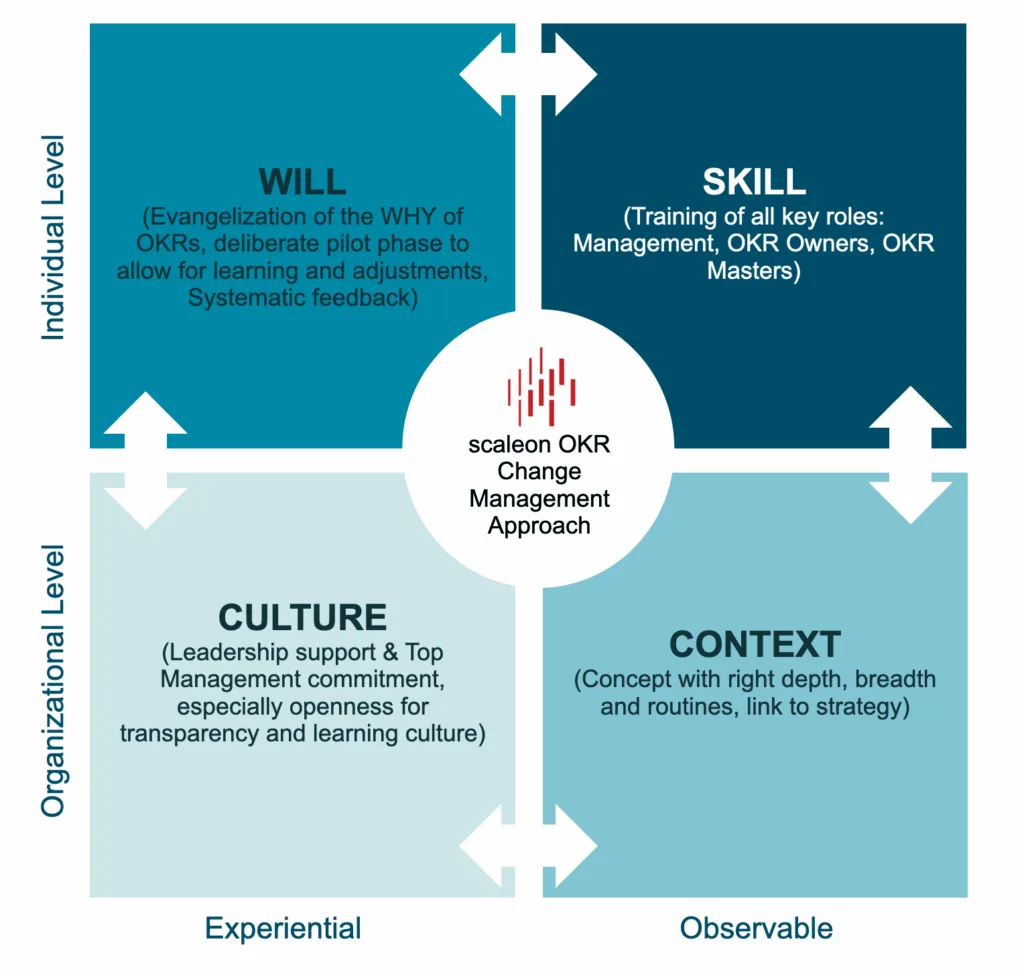
An effective approach accounts for all four levels of organisational reality:
- Individual-interior: attitudes, emotions, mindset
- Individual-exterior: behaviour, capabilities, results
- Collective-interior: culture, values, implicit rules
- Collective-exterior: structures, processes, systems
Interventions on one level shift the others, which is why training on its own changes little: it addresses capability and leaves in place the structure that penalises using it. The design question is which one or two levels carry the change in this specific organisation.
The test a target picture has to pass
Three questions, answered in a form people can repeat: why the change is happening, what specifically changes, and what the path there is. Then the test. Can someone two levels down state all three without the deck? If not, the target picture exists only in the steering committee.
Why change management starts with the executive team
Change management only succeeds when leaders visibly embody the change:
- Consistently modelling the new principles
- Connecting the strategy to what a team does on Monday
- Creating space for reflection
- Saying what is not yet decided instead of implying it is
- Naming the trade-off the change imposes rather than presenting it as upside only
The first real test is what happens when the new rules are inconvenient for the person who announced them. Everyone reads that moment, and it settles the credibility of the programme faster than any communication plan.
What resistance tells you about the change
Resistance is information about where the change has no answer yet. Four ways to get at it:
- Open dialogue, including with the people who will lose scope
- Early results that are visible without a report
- Participation while the design is still open
- Deliberate recruitment of the sharpest critics into the design team
Most resistance resolves into one of three things: the change makes no sense from where the person sits, it is unclear what happens to them, or they are losing something specific. The three need different answers, and treating all of them as a communication problem is why the standard response fails.
Culture is what people do when the programme stops watching
Change only becomes stable when it is anchored in culture. Change management therefore also means:
- Replacing symbolic gestures with behaviour
- Changing the feedback and appraisal system, because that is where the old behaviour is still rewarded
- Moving decision rights down and leaving them there
- Changing the meeting rituals, which is where the operating culture actually lives
A learning culture is measurable in one behaviour: whether a failed initiative gets discussed with its owner in the room. Where that does not happen, the organisation stops reporting problems early, and every later change costs more than it needed to.
What Kotter, ADKAR and the Change Kaleidoscope each force into the open
The following frameworks have proven their worth in practice:
- Kotter: eight steps from creating a sense of urgency to anchoring change
- ADKAR: individual change logic (Awareness, Desire, Knowledge, Ability, Reinforcement)
- Change Kaleidoscope: context-sensitive strategy design
- Digital tools: progress tracking, feedback integration, collaborative learning
None of them decides the outcome. They differ in what they force into the open, so pick the one that names your actual uncertainty. Combining two of them adds vocabulary, not clarity.
What a change programme looks like in a mid-sized company
A typical sequence in a mid-sized company:
- Developing a service-oriented vision
- Dissolving outdated silo structures
- Investing in digital capabilities
- Cultural development with clear symbols and behavioural expectations
- Building a cross-functional change core
- Establishing spaces for experimentation
The recurring success factors: iteration instead of a single plan, visible leadership presence, and one story that everyone tells the same way.
What to check six months into a change programme
Six months in, three questions separate a change that is taking hold from one that is being reported as taking hold. Can a team two levels down state what changed for them specifically? Has the appraisal system changed, or only the language in the town hall? And when the new way was inconvenient for a senior leader, which way did it go?
If the honest answers are no, no, and the old way, the programme is producing status reports.
Change management: the questions we get asked most
What is change management?
Change management is the work of moving an organisation from its current way of working to an agreed new one, and of keeping that move on the executive agenda until it holds. It answers how, in what order, and with which capabilities. What should change is decided elsewhere, in the strategy or in the transformation design.
What is the difference between change management and transformation?
Transformation is the content of the change. Change management is the method by which the organisation gets there. The practical consequence is ownership: the transformation belongs to whoever owns the strategy, while the change belongs to whoever can stop competing initiatives and move budget. Where one person holds both, the programme has an easier start than usual.
Why do change management programmes fail?
Three causes account for most failures. The appraisal and budgeting systems still reward the behaviour the programme is trying to replace. Leaders exempt themselves from the new rules, which everyone reads as permission. And the programme runs alongside too many other initiatives without a priority ranking, so it becomes the one with no deadline. None of the three is a communication problem.
Which change management models are used in practice?
Kotter's eight steps sequence a programme from urgency through to anchoring the change. ADKAR locates a blockage in an individual across awareness, desire, knowledge, ability and reinforcement. The Change Kaleidoscope forces the context to be described before a design is chosen. They answer different questions, so the choice depends on what is uncertain.
Who should own change management in a company?
A named executive, not a project office. The reason is structural: the decisions a change programme needs, on budget, on priorities, and on which existing initiatives get stopped, sit above the level a programme manager can reach. A project office can run the mechanics, but ownership without the authority to stop things is administration.